
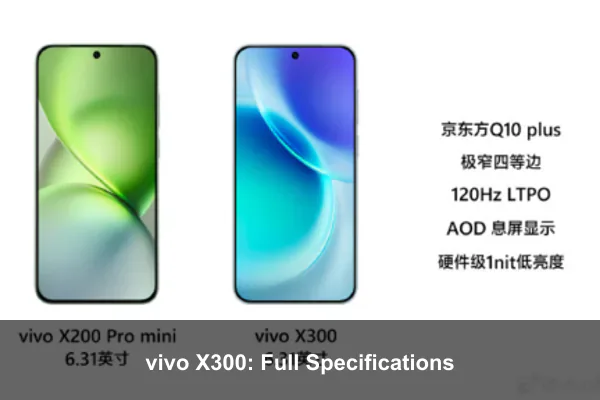
The vivo X300 targets buyers who want true flagship hardware in a more manageable form factor. It combines a compact body with high-end imaging, fast charging, and top-tier connectivity support.
Instead of competing only on one headline feature, the X300 positions itself as a balanced premium phone: powerful chipset, advanced ZEISS-tuned cameras, bright LTPO panel, and long real-world endurance backed by rapid wired and wireless charging.
Full Specifications
Network
| Technology: | GSM / HSPA / LTE / 5G |
| 2G bands: | GSM 850 / 900 / 1800 / 1900 |
| 3G bands: | HSDPA 850 / 900 / 1700(AWS) / 1900 / 2100 – International |
| HSDPA 850 / 900 / 2100 – Malaysia, India | |
| HSDPA 800 / 850 / 900 / 1700(AWS) / 1900 / 2100 – China | |
| 4G bands: | 1, 2, 3, 4, 5, 7, 8, 18, 19, 20, 25, 26, 28, 34, 38, 39, 40, 41, 42, 43, 48, 66 |
| 5G bands: | 1, 2, 3, 5, 7, 8, 18, 20, 25, 26, 28, 34, 38, 39, 40, 41, 48, 66, 77, 78 SA/NSA/Sub6 |
| Speed: | HSPA, LTE, 5G |
Launch
| Announced: | 2025, October 13 |
| Status: | Available. Released 2025, October 17 |
Body
| Dimensions: | 150.6 x 71.9 x 8 mm (5.93 x 2.83 x 0.31 in) |
| Weight: | 190 g (6.70 oz) |
| Build: | Glass front, aluminum alloy frame, glass back |
| SIM: | · Nano-SIM + Nano-SIM + eSIM (max 2 at a time) – International· Nano-SIM + Nano-SIM – China |
| IP68/IP69 dust tight and water resistant (high pressure water jets; immersible up to 1.5m for 30 min) |
Display
| Type: | LTPO AMOLED, 1B colors, 120Hz, 2160Hz PWM, HDR10+, HDR Vivid, 4500 nits (peak) |
| Size: | 6.31 inches, 98.0 cm2 (~90.5% screen-to-body ratio) |
| Resolution: | 1216 x 2640 pixels, 19.5:9 ratio (~460 ppi density) |
| Protection: | Reinforced Glass, Mohs level 4 |
| Ultra HDR image support |
Platform
| OS: | Android 16, up to 5 major Android upgrades, OriginOS 6 |
| Chipset: | Mediatek Dimensity 9500 (3 nm) |
| CPU: | Octa-core (1×4.21 GHz C1-Ultra & 3×3.5 GHz C1-Premium & 4×2.7 GHz C1-Pro) |
| GPU: | Arm G1-Ultra |
Memory
| Card slot: | No |
| Internal: | 256GB 12GB RAM, 256GB 16GB RAM, 512GB 12GB RAM, 512GB 16GB RAM, 1TB 16GB RAM |
| UFS 4.1 |
Main Camera
| Triple: | 200 MP, f/1.7, 23mm (wide), 1/1.4″, 0.56µm, PDAF, OIS 50 MP, f/2.6, 70mm (periscope telephoto), 1/1.95″, PDAF, OIS, 3x optical zoom 50 MP, f/2.0, 15mm, 119˚ (ultrawide), 1/2.76″, 0.64µm, AF |
| Features: | Laser AF, Zeiss optics, Zeiss T* lens coating, LED flash, panorama, HDR, 3D LUT import |
| Video: | 4K@30/60/120fps, 1080p@30/60/120/240fps, gyro-EIS, 4K@120fps HDR |
Selfie camera
| Single: | 50 MP, f/2.0, 20mm (wide), 1/2.76″, 0.64µm, AF |
| Features: | HDR |
| Video: | 4K@30/60fps, 1080p@30/60fps |
Sound
| Loudspeaker: | Yes, with stereo speakers |
| 3.5mm jack: | No |
Comms
| WLAN: | Wi-Fi 802.11 a/b/g/n/ac/6/7, dual-band |
| Bluetooth: | 5.4, A2DP, LE, aptX HD, LHDC 5 |
| Positioning: | GPS (L1+L5), GLONASS (L1), BDS (B1I+B1c+B2a+B2b), GALILEO (E1+E5a+E5b), QZSS (L1+L5), NavIC (L5) |
| NFC: | Yes |
| Infrared port: | Yes |
| Radio: | No |
| USB: | USB Type-C 3.2, OTG |
Features
| Sensors: | Fingerprint (under display, ultrasonic), accelerometer, gyro, proximity, compass |
Battery
| Type: | · Si/C Li-Ion 6040 mAh (Global)· Si/C Li-Ion 5360 mAh (EU markets) |
| Charging: | 90W wired 40W wireless Reverse wired |
Misc
| Colors: | Phantom Black, Mist Blue, Summit Red, Iris Purple, Halo Pink |
| Models: | V2515, V2509A |
| Price: | € 949.35 / ₹ 75,999 |
Our Tests
| Performance: | AnTuTu: 2346352 (v10), 3416530 (v11) GeekBench: 9843 (v6) 3DMark: 7510 (Wild Life Extreme) |
| Display: | 1930 nits max brightness (measured) |
| Loudspeaker: | -24.8 LUFS (Very good) |
| Battery: | Active use score 17:31h |
EU LABEL
| Energy: | Class A |
| Battery: | 52:15h endurance, 1200 cycles |
| Free fall: | Class B (180 falls) |
| Repairability: | Class C |
Price and Availability
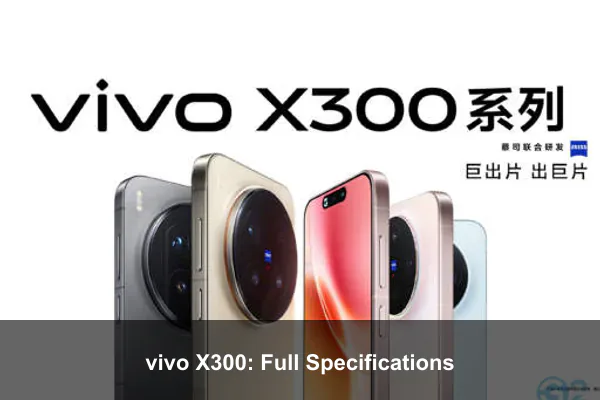
The vivo X300 offers a compelling combination of features and performance. While the base price is around €949, the actual cost may vary depending on your location and retailer. Below, you’ll find the approximate price of the vivo X300 converted into various currencies. Please note that these are estimates based on recent exchange rates as of April 20, 2026 and may not reflect the exact price you’ll find at a retailer.
- United States: $1,115
- Japan: ¥177,402
- United Kingdom: £827
- Australia: A$1,562
- Canada: C$1,528
- Taiwan: NT$35,158
- Denmark: kr7.083
- Saudi Arabia: ﷼4,183
- South Korea: ₩1,647,125
- Germany: €949
- Brazil: R$5.574
- Vietnam: ₫29.128.984
- Kenya: KSh 144,452
- India: ₹1,03,518
- Indonesia: Rp 19.177.658
- Nigeria: ₦1,503,061
- Pakistan: ₨311,320
- Philippines: ₱66,748
- Bangladesh: ৳১,৩৭,১৭৭
Value Position in the 2025 Flagship Segment
At around €949.35 / ₹75,999, the vivo X300 sits in upper-premium territory but offers a complete flagship bundle rather than a single standout spec. Its strongest value case is for buyers who want compact dimensions without stepping down to midrange performance or cameras.
Design and Build Quality
The phone keeps a practical premium design: glass front and back with an aluminum-alloy frame, plus IP68/IP69 resistance. At 150.6 x 71.9 x 8 mm and 190 g, it is easier to handle than many large-screen rivals while still feeling substantial.
Display Experience
The 6.31-inch LTPO AMOLED panel is tuned for flagship viewing with 120Hz refresh, HDR support, and very high peak brightness claims, while measured brightness remains strong in real use. This setup makes the X300 competitive for outdoor visibility, smooth UI navigation, and HDR media playback.
Performance and Thermal Headroom
With the 3 nm Dimensity 9500 platform, UFS 4.1 storage, and high benchmark scores, the X300 is positioned for sustained high-end workloads including gaming, editing, and heavy multitasking. Multiple memory tiers up to 1TB/16GB also help it stay relevant for long-term power users.
Camera System: Imaging Versatility First
The triple rear setup prioritizes flexibility: high-resolution main camera, periscope telephoto, and autofocus ultrawide. ZEISS optics, T* coating, laser AF, and advanced video options up to 4K 120fps HDR indicate a camera package built for both stills consistency and creator-focused video workflows.
Battery Life and Charging Practicality
Battery strategy varies by market, with a larger global cell and a smaller EU variant, so buyers should confirm their regional model before purchase. Even so, the active-use result is strong, and the combination of 90W wired plus 40W wireless charging keeps downtime short.
Software and Longevity
Android 16 with up to five major Android upgrades gives the X300 a credible long support window for a non-Google flagship. For buyers comparing long-term ownership cost, this update policy significantly improves the phone’s value beyond launch year.
Connectivity and Regional Readiness

The X300 is broadly equipped for global use with extensive 5G support, Wi-Fi 7, Bluetooth 5.4, NFC, USB-C 3.2, and even infrared. Dual-SIM plus eSIM flexibility on international units improves travel convenience, while China models keep a dual physical SIM approach.
Who Should Buy the vivo X300?
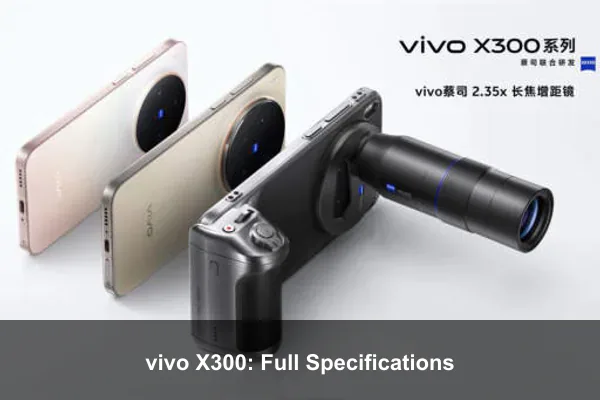
This phone is best for users who want a compact flagship that does not compromise on camera hardware, display quality, or charging speed. It is a strong pick for mobile photographers, frequent travelers, and premium Android buyers who prioritize balanced performance over oversized form factors.
Conclusion
The vivo X300 delivers a well-rounded flagship formula in a compact body, with particular strengths in imaging, display quality, and charging convenience. If your priority is premium all-around performance without moving to a larger phone, it is an easy recommendation.
