
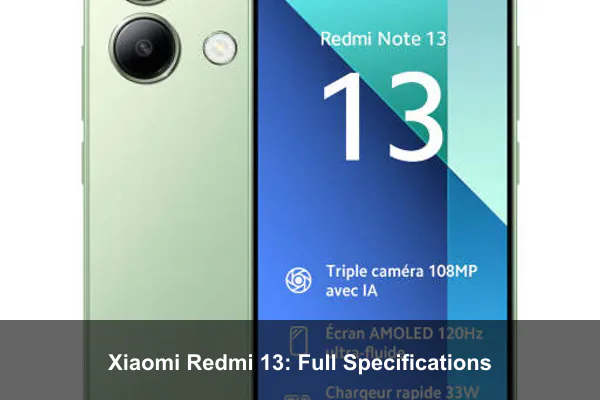
Xiaomi Redmi 13 is built for buyers who want a modern big-screen phone at a low entry price. It combines a 90Hz FHD+ display, a 108MP main camera, and a large 5030mAh battery in a 4G-focused package.
Instead of repeating the full spec sheet, this article looks at where the Redmi 13 delivers the most value, where it compromises, and who should consider it against similarly priced alternatives.
Full Specifications
Network
| Technology: | GSM / HSPA / LTE |
| 2G bands: | GSM 850 / 900 / 1800 / 1900 |
| 3G bands: | HSDPA 850 / 900 / 2100 |
| 4G bands: | 1, 3, 5, 7, 8, 20, 28, 38, 40, 41 |
| Speed: | HSPA, LTE |
Launch
| Announced: | 2024, June 03 |
| Status: | Available. Released 2024, June 03 |
Body
| Dimensions: | 168.6 x 76.3 x 8.3 mm (6.64 x 3.00 x 0.33 in) |
| Weight: | 205 g (7.23 oz) |
| Build: | Glass front, plastic frame, glass back |
| SIM: | Nano-SIM + Nano-SIM |
| IP53 dust protected and water resistant (vertical water sprays) |
Display
| Type: | IPS LCD, 90Hz, 550 nits (HBM) |
| Size: | 6.79 inches, 109.5 cm2 (~85.1% screen-to-body ratio) |
| Resolution: | 1080 x 2460 pixels (~396 ppi density) |
| Protection: | Corning Gorilla Glass |
Platform
| OS: | Android 14, HyperOS |
| Chipset: | Mediatek Helio G91 Ultra (12 nm) |
| CPU: | Octa-core (2×2.0 GHz Cortex-A75 & 6×1.8 GHz Cortex-A55) |
| GPU: | Mali-G52 MC2 |
Memory
| Card slot: | microSDXC (uses shared SIM slot) |
| Internal: | 128GB 6GB RAM, 128GB 8GB RAM, 256GB 6GB RAM, 256GB 8GB RAM |
| eMMC 5.1 |
Main Camera
| Dual: | 108 MP, f/1.8, (wide), 1/1.67″, 0.64µm, PDAF 2 MP, f/2.4, (macro) |
| Features: | LED flash, HDR |
| Video: | 1080p@30fps |
Selfie camera
| Single: | 13 MP, f/2.5, (wide) |
| Features: | HDR |
| Video: | 1080p@30fps |
Sound
| Loudspeaker: | Yes |
| 3.5mm jack: | Yes |
Comms
| WLAN: | Wi-Fi 802.11 a/b/g/n/ac, dual-band |
| Bluetooth: | 5.4, A2DP, LE |
| Positioning: | GPS, GLONASS, GALILEO, BDS |
| NFC: | Yes (market/region dependent) |
| Infrared port: | Yes |
| Radio: | FM radio |
| USB: | USB Type-C |
Features
| Sensors: | Fingerprint (side-mounted), accelerometer, compass |
| Virtual proximity sensing |
Battery
| Type: | 5030 mAh |
| Charging: | 33W wired |
Misc
| Colors: | Midnight Black, Sandy Gold, Ocean Blue, Pink |
| Models: | 2404ARN45A, 24040RN64Y |
| SAR EU: | 0.99 W/kg (head) 0.98 W/kg (body) |
| Price: | € 105.89 / $ 129.00 / £ 99.99 |
Our Tests
| Performance: | AnTuTu: 258090 (v9), 262438 (v10)
GeekBench: 1346 (v5), 1342 (v6) |
| Display: | 1300:1 contrast ratio, 448 nits max brightness (measured) |
| Loudspeaker: | -29.9 LUFS (Average) |
| Battery: | Active use score 10:28h |
Price and Availability
The Xiaomi Redmi 13 offers a compelling combination of features and performance. While the base price is around €106, the actual cost may vary depending on your location and retailer. Below, you’ll find the approximate price of the Xiaomi Redmi 13 converted into various currencies. Please note that these are estimates based on recent exchange rates as of April 3, 2026 and may not reflect the exact price you’ll find at a retailer.
- United States: $122
- Japan: ¥19,476
- United Kingdom: £92
- Australia: A$177
- Canada: C$170
- Taiwan: NT$3,903
- Denmark: kr790
- Saudi Arabia: ﷼458
- South Korea: ₩184,566
- Germany: €106
- Brazil: R$630
- Vietnam: ₫3.209.387
- Kenya: KSh 15,894
- India: ₹11,358
- Indonesia: Rp 2.073.766
- Nigeria: ₦168,713
- Pakistan: ₨34,068
- Philippines: ₱7,379
- Bangladesh: ৳১৪,৯৭২
Value and Market Position
The Redmi 13 follows a practical value formula: strong headline hardware for the price, then selective compromises to stay affordable. Compared with many budget options, it gives you a sharper FHD+ panel and high-resolution main camera, but skips 5G and uses eMMC 5.1 storage.
Design and In-Hand Feel
You get a glass front and glass back with a plastic frame, plus IP53 protection against dust and light vertical sprays. At 205 g and 6.79 inches, this is a large phone, so it feels more stable for media use than compact for one-handed handling.
Display Quality for Daily Use
The 6.79-inch IPS LCD runs at 90Hz with 1080 x 2460 resolution, which is a solid setup for smooth scrolling and sharper text than basic HD panels. In testing, measured max brightness is 448 nits and contrast is 1300:1, so indoor visibility is good, while strong outdoor sun can still be a challenge.
Performance and Responsiveness
With the Helio G91 Ultra and octa-core CPU, the Redmi 13 is aimed at routine tasks like messaging, social apps, video streaming, and light gaming. Benchmark results (AnTuTu up to 262438 in v10 and GeekBench around 1342 in v6) place it in the entry segment, where consistency matters more than peak speed.
Camera Practicality
The 108MP main camera with PDAF is the real highlight, especially for daylight shots where detail is the priority. The second rear lens is a 2MP macro, so this is not a versatile multi-camera system, and both rear and selfie video top out at 1080p at 30fps.
Battery Life and Charging
A 5030mAh battery plus 33W wired charging keeps the Redmi 13 competitive for day-to-day endurance. The tested active use score of 10:28h supports its role as a dependable all-day phone for moderate users.
Software Experience
Out of the box, it runs Android 14 with HyperOS, giving a current software base for new buyers. The feature set is practical, including side fingerprint unlock and virtual proximity sensing, but no explicit long-term update commitment is listed in the provided data.
Connectivity and Everyday Extras
This phone is very strong for legacy-friendly usability: dual SIM, microSD expansion (shared slot), 3.5mm headphone jack, FM radio, infrared port, and USB-C. NFC support is market dependent, so buyers should confirm regional variant details before purchase.
Who Should Buy Xiaomi Redmi 13
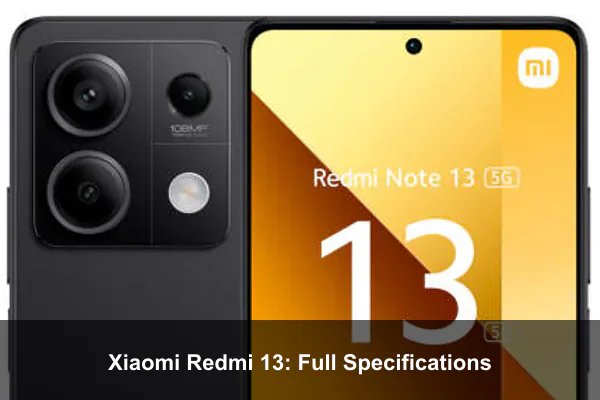
Choose the Redmi 13 if you want a low-cost phone with a large FHD+ 90Hz display, long battery life, and useful extras like headphone jack and microSD. Look elsewhere if your priorities are 5G data speeds, stronger gaming graphics, or more flexible camera hardware.
Conclusion
Xiaomi Redmi 13 is a smart budget pick for users who value screen quality, battery reliability, and practical features over 5G and flagship-level performance.
