
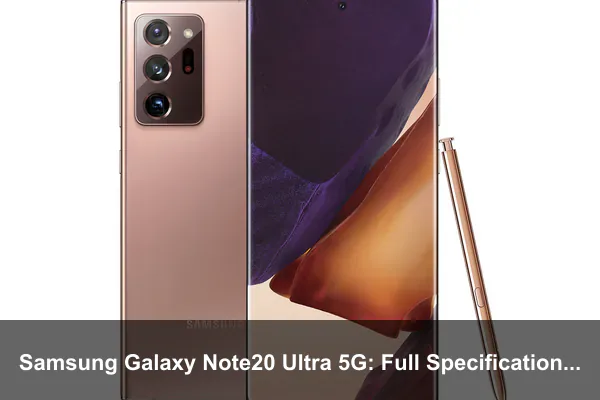
Samsung Galaxy Note20 Ultra 5G is a premium large-screen Samsung phone that combines flagship materials, an integrated S Pen, and broad 5G support in one device.
Instead of repeating a raw spec sheet, this overview takes a 2026 buyer angle: which variant to target, where the hardware still feels premium, and where age now matters most.
Full Specifications
Network
| Technology | GSM / CDMA / HSPA / EVDO / LTE / 5G |
| 2G bands | GSM 850 / 900 / 1800 / 1900 |
| CDMA 800 / 1900 | |
| 3G bands | HSDPA 850 / 900 / 1700(AWS) / 1900 / 2100 |
| CDMA2000 1xEV-DO | |
| 4G bands | 1, 2, 3, 4, 5, 7, 8, 12, 13, 14, 18, 19, 20, 25, 26, 28, 29, 30, 38, 39, 40, 41, 46, 48, 66, 71 – SM-N986U |
| 1, 2, 3, 4, 5, 7, 8, 12, 13, 17, 18, 19, 20, 25, 26, 28, 32, 38, 39, 40, 41, 66 – SM-N986B | |
| 2, 3, 4, 5, 7, 8, 12, 13, 18, 19, 20, 25, 29, 30, 38, 39, 40, 41, 46, 66, 71 – SM-N986W | |
| 5G bands | 2, 5, 41, 66, 71, 260, 261 SA/NSA/Sub6/mmWave – SM-N986U |
| 1, 3, 5, 7, 8, 28, 40, 77, 78 SA/NSA/Sub6 – SM-N986B | |
| 41, 66, 71 Sub6 – SM-N986W | |
| Speed | HSPA 42.2/5.76 Mbps, LTE (7CA) Cat20 2000/200 Mbps, 5G |
Launch
| Announced | 2020, August 05 |
| Status | Available. Released 2020, August 21 |
Body
| Dimensions | 164.8 x 77.2 x 8.1 mm (6.49 x 3.04 x 0.32 in) |
| Weight | 208 g (7.34 oz) |
| Build | Glass front (Gorilla Glass Victus), glass back (Gorilla Glass Victus), stainless steel frame |
| SIM | · Nano-SIM + eSIM· Nano-SIM + Nano-SIM |
| IP68 dust tight and water resistant (immersible up to 1.5m for 30 min) Stylus, 9ms latency (Bluetooth integration, accelerometer, gyro) |
Display
| Type | Dynamic AMOLED 2X, 120Hz, HDR10+ |
| Size | 6.9 inches, 116.7 cm2 (~91.7% screen-to-body ratio) |
| Resolution | 1440 x 3088 pixels, 19.3:9 ratio (~496 ppi density) |
| Protection | Corning Gorilla Glass Victus |
| 120Hz@FHD/60Hz@QHD refresh rate |
Platform
| OS | Android 10, upgradable to Android 13, One UI 5 |
| Chipset | Exynos 990 (7 nm+) – GlobalQualcomm SM8250 Snapdragon 865 5G+ (7 nm+) – USA |
| CPU | Octa-core (2×2.73 GHz Mongoose M5 & 2×2.50 GHz Cortex-A76 & 4×2.0 GHz Cortex-A55) – GlobalOcta-core (1×3.0 GHz Kryo 585 & 3×2.42 GHz Cortex-A77 & 4×1.80 GHz Cortex-A55) – USA |
| GPU | Mali-G77 MP11 – GlobalAdreno 650 – USA |
Memory
| Card slot | microSDXC (uses shared SIM slot) |
| Internal | 128GB 6GB RAM, 128GB 8GB RAM, 128GB 12GB RAM, 256GB 8GB RAM, 256GB 12GB RAM, 512GB 12GB RAM |
| UFS 3.0 |
Main Camera
| Triple | 108 MP, f/1.8, 26mm (wide), 1/1.33", 0.8µm, PDAF, OIS 12 MP, f/3.0, 120mm (periscope telephoto), 1.0µm, PDAF, OIS, 5x optical zoom, 50x hybrid zoom 12 MP, f/2.2, 120˚, 13mm (ultrawide), 1/2.55", 1.4µm |
| Features | Laser AF, LED flash, auto-HDR, panorama |
| Video | 8K@24fps, 4K@30/60fps, 1080p@30/60/240fps, 720p@960fps, HDR10+, stereo sound rec., gyro-EIS & OIS |
Selfie camera
| Single | 10 MP, f/2.2, 26mm (wide), 1/3.2", 1.22µm, dual pixel PDAF |
| Features | HDR |
| Video | 4K@30/60fps, 1080p@30fps |
Sound
| Loudspeaker | Yes, with stereo speakers |
| 3.5mm jack | No |
| High-bitrate audio support Tuned by AKG |
Comms
| WLAN | Wi-Fi 802.11 a/b/g/n/ac/6, dual-band, Wi-Fi Direct |
| Bluetooth | 5.0, A2DP, LE, aptX |
| Positioning | GPS, GLONASS, BDS, GALILEO |
| NFC | Yes |
| Radio | FM radio (Snapdragon model only; market/operator dependent) |
| USB | USB Type-C 3.2, OTG |
Features
| Sensors | Fingerprint (under display, ultrasonic), accelerometer, gyro, proximity, compass, barometer |
| Samsung Wireless DeX (desktop experience support) ANT+ Ultra Wideband (UWB) support |
Battery
| Type | Li-Ion 4500 mAh |
| Charging | 25W wired, PD3.0 15W wireless (Qi) 4.5W reverse wireless |
Misc
| Colors | Mystic Bronze, Mystic Black, Mystic White |
| Models | SM-N986B, SM-N986B/DS, SM-N986U, SM-N986U1, SM-N986W, SM-N9860, SM-N986N, SC-53A |
| SAR | 0.71 W/kg (head) 1.18 W/kg (body) |
| SAR EU | 0.34 W/kg (head) 1.47 W/kg (body) |
| Price | C$ 706.91 / $ 247.59 / € 479.99 |
Our Tests
| Performance | AnTuTu: 508760 (v8) GeekBench: 2603 (v5.1) GFXBench: 42fps (ES 3.1 onscreen) |
| Display | 1024 nits max brightness (measured) |
| Camera | Photo / Video |
| Loudspeaker | -27.8 LUFS (Good) |
| Battery (old) | Endurance rating 88h |
Price and Availability
The Samsung Galaxy Note20 Ultra 5G offers a compelling combination of features and performance. While the base price is around €480, the actual cost may vary depending on your location and retailer. Below, you’ll find the approximate price of the Samsung Galaxy Note20 Ultra 5G converted into various currencies. Please note that these are estimates based on recent exchange rates as of April 18, 2026 and may not reflect the exact price you’ll find at a retailer.
- United States: $566
- Japan: ¥89,713
- United Kingdom: £418
- Australia: A$788
- Canada: C$774
- Taiwan: NT$17,836
- Denmark: kr3.582
- Saudi Arabia: ﷼2,121
- South Korea: ₩832,188
- Germany: €480
- Brazil: R$2.821
- Vietnam: ₫14.851.606
- Kenya: KSh 73,208
- India: ₹52,568
- Indonesia: Rp 9.705.298
- Nigeria: ₦768,498
- Pakistan: ₨157,628
- Philippines: ₱34,002
- Bangladesh: ৳৬৯,৫৬৩
Value Position in 2026
At the listed price points (C$ 706.91 / $ 247.59 / € 479.99), the Galaxy Note20 Ultra 5G can land anywhere from value-flagship to premium-refurb territory depending on region. Against many newer midrange phones, it still differentiates itself with S Pen features, DeX support, and true periscope zoom hardware.
Design and Build Quality
The phone still feels unmistakably high-end: Gorilla Glass Victus on both sides, a stainless steel frame, and IP68 protection. It is large and heavy at 208 g, but that footprint supports productivity use, while the built-in S Pen with 9ms latency keeps the Note identity intact.
Display Experience
The 6.9-inch Dynamic AMOLED 2X panel remains a key selling point, with sharp QHD+ resolution, HDR10+, and strong measured brightness (1024 nits max). The main trade-off is refresh behavior: 120Hz at FHD and 60Hz at QHD, so buyers must choose between maximum smoothness and maximum resolution.
Performance and Chipset Variants
Model choice is critical because performance differs by region: Exynos 990 (global) versus Snapdragon 865 5G+ (USA). The provided benchmark set (AnTuTu 508760, GeekBench 2603, GFXBench 42fps) indicates solid flagship-class foundations for daily use, and UFS 3.0 storage helps sustain responsive app loading.
Camera Strengths
The triple camera setup is still versatile: a high-resolution 108 MP main sensor, 5x optical periscope telephoto, and ultrawide coverage. Video options are extensive with 8K recording, 4K up to 60fps, HDR10+, stereo recording, and combined OIS/EIS support, making it useful for users who want both zoom reach and creator-friendly video formats.
Battery and Charging Practicality
A 4500 mAh battery with 25W wired charging, 15W wireless charging, and 4.5W reverse wireless charging remains practical for power users. The historical endurance figure (88h) was competitive for its class, but current real-world stamina will depend heavily on battery condition and device age.
Software Lifecycle and Usability
The device launched on Android 10 and is listed as upgradable to Android 13 with One UI 5. That gives a clear software ceiling for buyers comparing it with newer phones, so long-term app support expectations should be part of the purchase decision.
Connectivity and Productivity Extras
Connectivity is one of this model’s strongest long-term advantages: broad 4G/5G band coverage, Wi-Fi 6, NFC, Bluetooth 5.0 with aptX, USB-C 3.2, and Samsung Wireless DeX. Variant differences matter here too, including mmWave availability on SM-N986U and market-dependent FM radio on Snapdragon models.
Who Should Buy the Galaxy Note20 Ultra 5G
This phone is best for users who prioritize pen input, large-screen multitasking, camera flexibility, and Samsung’s desktop-style workflow features. It is less ideal for buyers who want a compact body, a 3.5mm jack, or a newer software-generation starting point.
Conclusion
Samsung Galaxy Note20 Ultra 5G remains a strong specs-driven option for users who want S Pen productivity, a premium AMOLED display, and versatile zoom camera hardware in one device. For the smartest purchase, choose the right regional model, prioritize battery health, and aim for higher RAM/storage trims.
