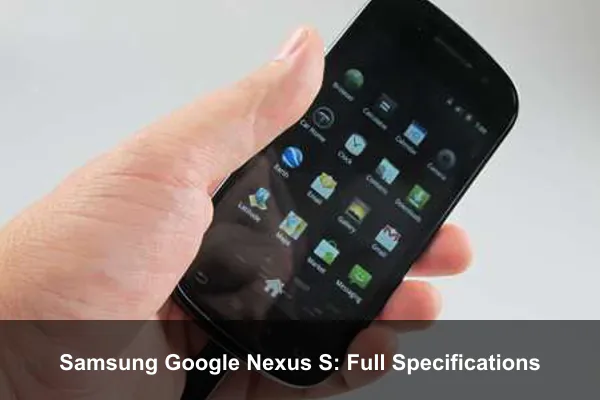
The Samsung Google Nexus S is a classic Android reference phone from the early Nexus era, built around clean Google software, compact hardware, and Samsung’s Super AMOLED display technology.
This article looks at the Nexus S as a legacy smartphone: useful for collectors, Android history fans, and light retro use, but clearly limited by modern app, network, storage, and camera expectations.
Full Specifications
Network
| Technology |
GSM / HSPA |
| 2G bands |
GSM 850 / 900 / 1800 / 1900 |
| 3G bands |
HSDPA 900 / 1700 / 2100 |
| Speed |
HSPA 7.2/5.76 Mbps |
Launch
| Announced |
2010, December. Released 2010, December |
| Status |
Discontinued |
Body
| Dimensions |
123.9 x 63 x 10.9 mm (4.88 x 2.48 x 0.43 in) |
| Weight |
129 g (4.55 oz) |
| SIM |
Mini-SIM |
Display
| Type |
Super AMOLED |
| Size |
4.0 inches, 45.5 cm2 (~58.3% screen-to-body ratio) |
| Resolution |
480 x 800 pixels, 5:3 ratio (~233 ppi density) |
| Protection |
Oleophobic coating |
Platform
| OS |
Android 2.3 (Gingerbread), 4.1.2 (Jelly Bean), not upgradable to 4.2 (Jelly Bean) |
| Chipset |
Hummingbird |
| CPU |
1.0 GHz Cortex-A8 |
| GPU |
PowerVR SGX540 |
Memory
| Card slot |
No |
| Internal |
16GB 512MB RAM |
Main Camera
| Single |
5 MP, AF |
| Features |
LED flash |
| Video |
w480p@30fps |
Selfie camera
Sound
| Loudspeaker |
Yes |
| 3.5mm jack |
Yes |
Comms
| WLAN |
Wi-Fi 802.11 b/g/n, DLNA, hotspot |
| Bluetooth |
2.1, A2DP |
| Positioning |
GPS, A-GPS |
| NFC |
Yes |
| Radio |
No |
| USB |
microUSB 2.0 |
Features
| Sensors |
Accelerometer, gyro, proximity, compass |
| Browser |
HTML, Adobe Flash |
|
MP4/H.264 player MP3/WAV/eAAC+ player Organizer Photo/video editor Voice memo/dial/commands Predictive text input Near Field Communications |
Battery
| Type |
Removable Li-Ion 1500 mAh battery |
| Stand-by |
Up to 713 h (2G) / Up to 428 h (3G) |
| Talk time |
Up to 14 h (2G) / Up to 6 h 40 min (3G) |
Misc
| Colors |
Black, White |
| SAR |
0.58 W/kg (head) 0.90 W/kg (body) |
| SAR EU |
0.47 W/kg (head) |
| Price |
About 170 EUR |
Our Tests
| Camera |
Photo |
| Loudspeaker |
Voice 68dB / Noise 66dB / Ring 69dB |
| Audio quality |
Noise -90.2dB / Crosstalk -90.8dB |
Price and Availability
The Samsung Google Nexus S offers a compelling combination of features and performance. While the base price is around €170, the actual cost may vary depending on your location and retailer. Below, you’ll find the approximate price of the Samsung Google Nexus S converted into various currencies. Please note that these are estimates based on recent exchange rates as of May 13, 2026 and may not reflect the exact price you’ll find at a retailer.
- United States: $200
- Japan: ¥31,453
- United Kingdom: £147
- Australia: A$276
- Canada: C$273
- Taiwan: NT$6,289
- Denmark: kr1.269
- Saudi Arabia: ﷼748
- South Korea: ₩297,361
- Germany: €170
- Brazil: R$977
- Vietnam: ₫5.205.559
- Kenya: KSh 25,794
- India: ₹19,080
- Indonesia: Rp 3.495.816
- Nigeria: ₦270,887
- Pakistan: ₨55,667
- Philippines: ₱12,269
- Bangladesh: ৳২৪,৫৩০
Why Should You Buy the Samsung Google Nexus S?
The main reason to consider the Samsung Google Nexus S today is its historical value. It was one of the first phones to showcase Android 2.3 Gingerbread and later received Android 4.1.2 Jelly Bean, making it a meaningful device for anyone interested in the evolution of stock Android.
Design and Build
With a 4.0-inch display, 129 g weight, and removable battery, the Nexus S feels very different from modern large-screen smartphones. Its compact body and Mini-SIM setup make it more of a retro handset than a practical primary phone in 2026.
Display Quality
The Super AMOLED panel is one of the phone’s standout features for its generation. The 480 x 800 resolution is low by current standards, but the contrast and color characteristics help explain why this model was considered premium in its time.
Performance and Storage
The Hummingbird chipset, 1.0 GHz Cortex-A8 CPU, PowerVR SGX540 GPU, and 512MB RAM are suitable only for period-correct Android tasks. The 16GB internal storage is fixed because there is no memory card slot, so storage flexibility is limited.
Camera Experience
The 5 MP autofocus rear camera with LED flash is basic today, and video tops out at w480p at 30fps. The VGA selfie camera is best viewed as a utility feature for its era rather than a modern front-camera experience.
Battery Life
The removable 1500 mAh Li-Ion battery is a practical advantage for a legacy phone, as it can be replaced more easily than sealed batteries. Real-world endurance will depend heavily on battery condition because this model is long discontinued.
Software Legacy
The Nexus S is important because of its clean Google Android experience and its path from Gingerbread to Jelly Bean. However, the lack of upgrade support beyond Android 4.1.2 means modern app compatibility and security are major limitations.
Connectivity
The phone supports GSM and HSPA networks, Wi-Fi b/g/n, Bluetooth 2.1, GPS with A-GPS, microUSB 2.0, and NFC. The presence of NFC is especially notable because it made the Nexus S an early showcase for near field communication on Android.
Who Should Buy This Phone?
The Samsung Google Nexus S is best for collectors, Android enthusiasts, repair hobbyists, or users who want a compact historical device for basic offline or legacy use. It is not a strong choice for modern apps, photography, gaming, banking, or long-term secure daily use.
Conclusion
The Samsung Google Nexus S remains an important Android milestone thanks to its stock Google software, Super AMOLED display, NFC support, and removable battery. Buy it for nostalgia or collection value, not as a modern daily driver.