
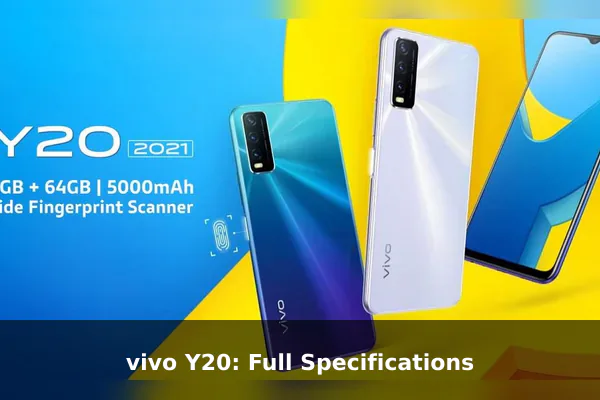
The vivo Y20 arrived in late August 2020 as an entry-level option aimed at first-time smartphone buyers and budget-conscious shoppers who still want a large screen, a long-lasting battery, and a recognizable brand. With a launch price of around 150 EUR, it positioned itself as a no-frills daily driver rather than a spec-chasing flagship.
What makes the Y20 interesting in hindsight is how it balances modest internals with practical extras that budget users actually use: a dedicated microSD slot, a 3.5mm headphone jack, an FM radio, and a side-mounted fingerprint reader. This article breaks down where the Y20 still makes sense and where its age starts to show.
Full Specifications
Network
| Technology | GSM / HSPA / LTE |
| 2G bands | GSM 850 / 900 / 1800 / 1900 |
| 3G bands | HSDPA 850 / 900 / 2100 |
| 4G bands | 1, 3, 5, 8, 38, 40, 41 |
| 1, 3, 5, 7, 8, 18, 19, 20, 26, 28, 38, 39, 40, 41 | |
| Speed | HSPA, LTE |
Launch
| Announced | 2020, August 26. Released 2020, August 28 |
| Status | Discontinued |
Body
| Dimensions | 164.4 x 76.3 x 8.4 mm (6.47 x 3.00 x 0.33 in) |
| Weight | 192.3 g (6.77 oz) |
| Build | Glass front, plastic back, plastic frame |
| SIM | Nano-SIM + Nano-SIM |
Display
| Type | IPS LCD |
| Size | 6.51 inches, 102.3 cm2 (~81.6% screen-to-body ratio) |
| Resolution | 720 x 1600 pixels, 20:9 ratio (~270 ppi density) |
Platform
| OS | Android 10, Funtouch 10.5 |
| Chipset | Qualcomm SM4250 Snapdragon 460 (11 nm) |
| CPU | Octa-core (4×1.8 GHz Kryo 240 & 4×1.6 GHz Kryo 240) |
| GPU | Adreno 610 |
Memory
| Card slot | microSDXC (dedicated slot) |
| Internal | 64GB 3GB RAM, 64GB 4GB RAM, 64GB 6GB RAM |
| eMMC 5.1 |
Main Camera
| Triple | 13 MP, f/2.2, (wide), PDAF 2 MP (macro) Auxiliary lens |
| Features | LED flash, HDR |
| Video | 1080p@30fps |
Selfie camera
| Single | 8 MP, f/1.8, (wide) |
| Video | 1080p@30fps |
Sound
| Loudspeaker | Yes |
| 3.5mm jack | Yes |
Comms
| WLAN | Wi-Fi 802.11 a/b/g/n/ac, dual-band, Wi-Fi Direct |
| Bluetooth | 5.0, A2DP, LE |
| Positioning | GPS, GLONASS, BDS, GALILEO |
| NFC | No |
| Radio | FM radio |
| USB | microUSB 2.0, OTG |
Features
| Sensors | Fingerprint (side-mounted), accelerometer, proximity, compass |
Battery
| Type | 5000 mAh |
| Charging | 18W wired |
Misc
| Colors | Obsidian Black, Dawn White, Purist Blue |
| Models | V2029, V2029_PK |
| SAR | 1.19 W/kg (head) 0.58 W/kg (body) |
| Price | About 150 EUR |
Price and Availability
The vivo Y20 offers a compelling combination of features and performance. While the base price is around €150, the actual cost may vary depending on your location and retailer. Below, you’ll find the approximate price of the vivo Y20 converted into various currencies. Please note that these are estimates based on recent exchange rates as of May 19, 2026 and may not reflect the exact price you’ll find at a retailer.
- United States: $175
- Japan: ¥27,751
- United Kingdom: £130
- Australia: A$244
- Canada: C$240
- Taiwan: NT$5,512
- Denmark: kr1.119
- Saudi Arabia: ﷼655
- South Korea: ₩261,455
- Germany: €150
- Brazil: R$881
- Vietnam: ₫4.566.706
- Kenya: KSh 22,597
- India: ₹16,821
- Indonesia: Rp 3.084.722
- Nigeria: ₦237,696
- Pakistan: ₨48,702
- Philippines: ₱10,779
- Bangladesh: ৳২১,৪৭২
Value at the Entry Level
At roughly 150 EUR, the vivo Y20 targets a price band where compromises are expected. What you get in return is a familiar vivo software experience, a 5000 mAh battery, and a 6.51-inch display, which are headline features that punch above the asking price for first-time buyers.
Design and Build
The Y20 measures 164.4 x 76.3 x 8.4 mm and weighs 192.3 g, putting it on the larger and slightly heavier side of budget phones. Its construction pairs a glass front with a plastic back and plastic frame, available in Obsidian Black, Dawn White, and Purist Blue. The side-mounted fingerprint sensor doubles as the power button, a practical touch at this price.
Display Experience
You get a 6.51-inch IPS LCD with a 720 x 1600 resolution and a 20:9 aspect ratio. Pixel density sits at around 270 ppi, which is acceptable for casual browsing, social media, and video, though text and fine detail will not look as crisp as on Full HD+ panels in slightly pricier rivals.
Performance and Memory
Under the hood is the Qualcomm Snapdragon 460 built on an 11 nm process, with an octa-core Kryo 240 CPU and Adreno 610 GPU. RAM options span 3GB, 4GB, and 6GB paired with 64GB of eMMC 5.1 storage, expandable via a dedicated microSDXC slot. It is tuned for everyday tasks rather than demanding games.
Cameras for Everyday Shots
The rear setup combines a 13 MP f/2.2 wide camera with PDAF and a 2 MP macro auxiliary lens, supported by LED flash and HDR. Video tops out at 1080p at 30fps on both the rear and the 8 MP f/1.8 selfie camera. It is a basic but serviceable kit for social sharing.
Battery Life and Charging
A 5000 mAh battery is the Y20’s strongest selling point, easily delivering a full day and often more on light to moderate use. The 18W wired charging is modest by today’s fast-charging standards, but reasonable for the segment when the phone launched.
Connectivity and Extras
The Y20 supports dual-band Wi-Fi 802.11 a/b/g/n/ac, Bluetooth 5.0, and full GNSS positioning across GPS, GLONASS, BDS, and GALILEO. Notable omissions include NFC and USB Type-C, with charging and data handled over microUSB 2.0 with OTG. The 3.5mm jack and FM radio remain, which budget users will appreciate.
Software
It ships with Android 10 and vivo’s Funtouch OS 10.5 on top. The interface offers plenty of customization but, given the phone’s age and entry-level status, long-term major Android version updates are not expected.
Who Should Consider the vivo Y20
The Y20 suits first-time smartphone owners, secondary-device buyers, students, and anyone needing a reliable communication phone with long battery life. Power users, mobile gamers, and photography enthusiasts should look at higher tiers instead.
Conclusion
The vivo Y20 is a sensible, no-surprises budget phone defined by its big 5000 mAh battery, large 6.51-inch display, and practical extras like microSD, 3.5mm jack, and FM radio. If your priorities are battery life, basic everyday use, and a familiar brand at around 150 EUR, it remains a defensible pick, with the caveat that microUSB charging and aging software hold it back from being a long-term investment.
