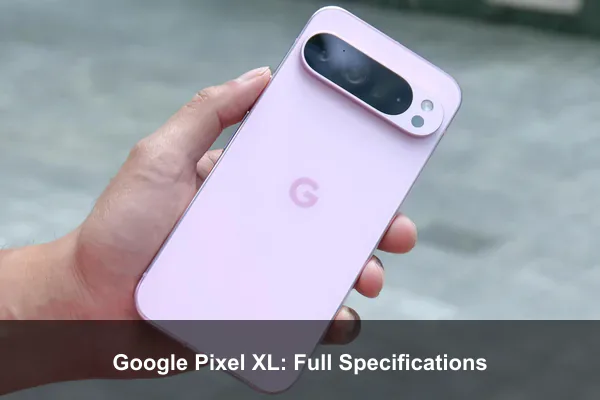
Google Pixel XL is Google’s first-generation Pixel flagship, announced in October 2016 and now discontinued. It combines a premium aluminum-and-glass build with a high-resolution AMOLED panel and official support up to Android 10.
This article takes a legacy-value angle, focusing on practical ownership in today’s market so you can compare it clearly against newer budget and midrange phones.
Price and Availability Google Pixel XL: Full Specifications. Image Source: pexels.com
The Google Pixel XL offers a compelling combination of features and performance. While the base price is around €400, the actual cost may vary depending on your location and retailer. Below, you’ll find the approximate price of the Google Pixel XL converted into various currencies. Please note that these are estimates based on recent exchange rates as of April 3, 2026 and may not reflect the exact price you’ll find at a retailer.
United States: $461
Japan: ¥73,571
United Kingdom: £349
Australia: A$669
Canada: C$642
Taiwan: NT$14,743
Denmark: kr2.984
Saudi Arabia: ﷼1,729
South Korea: ₩697,199
Germany: €400
Brazil: R$2.379
Vietnam: ₫12.123.475
Kenya: KSh 60,040
India: ₹42,906
Indonesia: Rp 7.833.660
Nigeria: ₦637,314
Pakistan: ₨128,692
Philippines: ₱27,875
Bangladesh: ৳৫৬,৫৫৯
Value in 2026
Pixel XL is most compelling as a legacy or secondary device rather than a long-term primary phone. Core strengths like sharp display quality, clean Pixel software style, and solid camera tuning still give it relevance if the price is right.
Design and Build Quality
The phone still feels premium for its era, with Gorilla Glass 4 on the front, an aluminum frame, and a distinctive metal-and-glass back. At 168 g, it is substantial without feeling overly heavy, and the water-repellent coating adds basic daily confidence.
Display Experience
The 5.5-inch QHD AMOLED panel remains a highlight, with high pixel density that keeps text and photos crisp. Compared with modern tall displays, the 16:9 format is less immersive for some apps but still excellent for standard video and reading.
Performance for Daily Use
Snapdragon 821, Adreno 530, and 4GB RAM are adequate for messaging, browsing, navigation, and light multitasking. Against current chipsets, demanding games and heavier modern workloads show clear performance limits.
Camera Strengths
The 12.3 MP rear camera with large 1.55um pixels, PDAF, and laser AF is still capable of detailed photos in good light. Video support is versatile for an older flagship, including 4K recording and multiple high-frame-rate options.
Battery and Charging
A 3450 mAh battery and 18W USB PD charging were strong at launch and remain usable for moderate routines. For any unit today, battery condition is the deciding factor, so real-world endurance depends heavily on cell health.
Software Position
Pixel XL launched on Android 7.1 and officially upgrades to Android 10. That keeps basic app usage viable, but software headroom is limited compared with newer devices that offer newer Android features and longer support windows.
Connectivity and Essentials
For a 4G-era phone, connectivity is well-rounded: broad LTE band support, dual-band Wi-Fi ac, NFC, Bluetooth with aptX, GPS/GLONASS, USB Type-C 3.0, and a 3.5mm headphone jack. This combination still covers everyday fundamentals reliably.
Who Should Buy Google Pixel XL?
It suits users who want a classic Google phone for photography character, media use, or backup duties. Buyers needing newer Android versions, stronger gaming performance, or newer-generation network features should look at more recent models.
Conclusion
Google Pixel XL remains a respectable legacy Pixel with standout display sharpness and a still-capable camera, but it is best bought as a secondary or enthusiast device, not as a future-proof daily driver.