
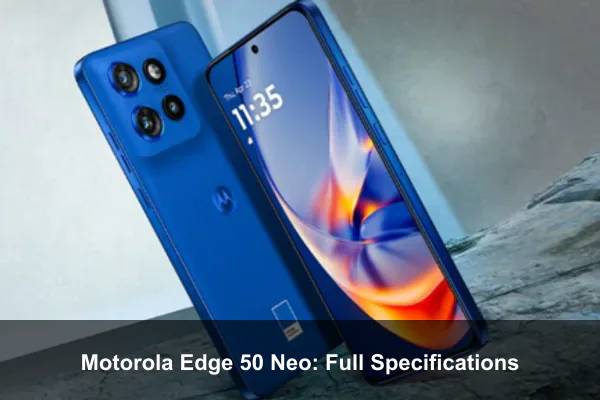
The Motorola Edge 50 Neo squeezes flagship-style ambition into a remarkably small frame, pairing a 6.4-inch LTPO P-OLED panel with a triple camera that includes a genuine 3x telephoto lens. Announced on August 29, 2024, it targets buyers who want premium hardware and a tidy footprint without paying ultra-tier money, slotting neatly between the value-driven Edge 50 Fusion and the more aggressive Edge 50 Ultra.
Built around MediaTek’s efficient Dimensity 7300, wrapped in an IP68-rated and MIL-STD-810H body, and backed by a promise of five Android upgrades, the Edge 50 Neo is one of the rare compact phones still trying to do everything. This article digs into where that compact, long-support strategy pays off and where the corners were cut.
Full Specifications
Network
| Technology: | GSM / HSPA / LTE / 5G |
| 2G bands: | GSM 850 / 900 / 1800 / 1900 |
| 3G bands: | HSDPA 800 / 850 / 900 / 1700(AWS) / 1900 / 2100 |
| 4G bands: | 1, 2, 3, 4, 5, 7, 8, 12, 13, 17, 18, 19, 20, 25, 26, 28, 32, 34, 38, 39, 40, 41, 42, 43, 48, 66 |
| 5G bands: | 1, 2, 3, 5, 7, 8, 20, 26, 28, 38, 40, 41, 66, 75, 77, 78 SA/NSA/Sub6 |
| Speed: | HSPA, LTE, 5G |
Launch
| Announced: | 2024, August 29 |
| Status: | Available. Released 2024, August 29 |
Body
| Dimensions: | 154.1 x 71.2 x 8.1 mm (6.07 x 2.80 x 0.32 in) |
| Weight: | 171 g (6.03 oz) |
| Build: | Glass front (Gorilla Glass 3), plastic frame, plastic back or silicone polymer (eco leather) back |
| SIM: | Nano-SIM + eSIMNano-SIM + Nano-SIM |
| IP68 dust tight and water resistant (immersible up to 1.5m for 30 min) MIL-STD-810H compliant* * does not guarantee ruggedness or use in extreme conditions |
Display
| Type: | LTPO P-OLED, 1B colors, 120Hz, HDR10+, 3000 nits (peak) |
| Size: | 6.4 inches, 97.5 cm2 (~88.9% screen-to-body ratio) |
| Resolution: | 1200 x 2670 pixels, 20:9 ratio (~460 ppi density) |
| Protection: | Corning Gorilla Glass 3, Mohs level 4 |
Platform
| OS: | Android 14, up to 5 major Android upgrades |
| Chipset: | Mediatek Dimensity 7300 (4 nm) |
| CPU: | Octa-core (4×2.5 GHz Cortex-A78 & 4×2.0 GHz Cortex-A55) |
| GPU: | Mali-G615 MC2 |
Memory
| Card slot: | No |
| Internal: | 256GB 8GB RAM, 256GB 12GB RAM, 512GB 12GB RAM |
| UFS 2.2 |
Main Camera
| Triple: | 50 MP, f/1.8, 24mm (wide), 1/1.55″, 1.0µm, multi-directional PDAF, OIS 10 MP, f/2.0, 73mm (telephoto), 1/3.94″, 1.0µm, PDAF, OIS, 3x optical zoom 13 MP, f/2.2, 13mm, 120˚ (ultrawide), 1/3.0″, 1.12µm, PDAF |
| Features: | LED flash, HDR, panorama |
| Video: | 4K@30fps, 1080p@30/60/120/240fps, gyro-EIS |
Selfie camera
| Single: | 32 MP, f/2.4, (wide), 1/3.14″, 0.7µm |
| Features: | HDR |
| Video: | 4K@30fps, 1080p@30/60/120fps |
Sound
| Loudspeaker: | Yes, with stereo speakers |
| 3.5mm jack: | No |
Comms
| WLAN: | Wi-Fi 802.11 a/b/g/n/ac/6e, tri-band |
| Bluetooth: | 5.3, A2DP, LE |
| Positioning: | GPS, GLONASS, GALILEO |
| NFC: | Yes |
| Radio: | No |
| USB: | USB Type-C 2.0 |
Features
| Sensors: | Fingerprint (under display, optical), accelerometer, gyro, proximity, compass |
| Smart Connect (Ready For) support |
Battery
| Type: | 4310 mAh |
| Charging: | 68W wired 15W wireless |
Misc
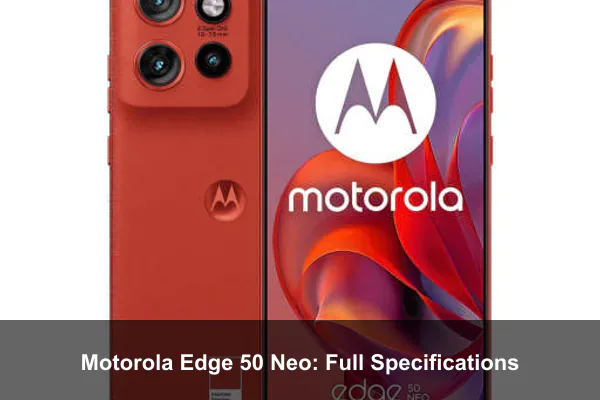
| Colors: | Nautical Blue, Latte, Grisaille, Poinciana, Mocha Mousse |
| Models: | XT2409-1 |
| Price: | € 278.07 / $ 635.00 / £ 230.99 / ₹ 21,990 |
Our Tests
| Performance: | AnTuTu: 696931 (v10) GeekBench: 2959 (v6) 3DMark: 855 (Wild Life Extreme) |
| Display: | 1437 nits max brightness (measured) |
| Loudspeaker: | -24.1 LUFS (Very good) |
| Battery: | Active use score 13:29h |
EU LABEL
| Energy: | Class A |
| Battery: | 50:44h endurance, 1200 cycles |
| Free fall: | Class B (180 falls) |
| Repairability: | Class B |
Price and Availability
The Motorola Edge 50 Neo offers a compelling combination of features and performance. While the base price is around €278, the actual cost may vary depending on your location and retailer. Below, you’ll find the approximate price of the Motorola Edge 50 Neo converted into various currencies. Please note that these are estimates based on recent exchange rates as of June 12, 2026 and may not reflect the exact price you’ll find at a retailer.
- United States: $321
- Japan: ¥51,492
- United Kingdom: £240
- Australia: A$458
- Canada: C$449
- Taiwan: NT$10,157
- Denmark: kr2.075
- Saudi Arabia: ﷼1,204
- South Korea: ₩490,449
- Germany: €278
- Brazil: R$1.654
- Vietnam: ₫8.431.509
- Kenya: KSh 41,570
- India: ₹30,704
- Indonesia: Rp 5.768.535
- Nigeria: ₦433,723
- Pakistan: ₨89,467
- Philippines: ₱19,678
- Bangladesh: ৳৩৯,৫১৫
Why Should You Buy the Motorola Edge 50 Neo
The Neo’s pitch is simple: a small, light, well-built phone that refuses to drop the features most compact rivals sacrifice. You get a high-refresh LTPO OLED, a three-camera system with optical zoom, wireless charging, NFC, and five years of major Android updates. For shoppers who find modern 6.7-inch slabs unwieldy, that combination is hard to find anywhere else at this price.
The trade-offs are deliberate rather than accidental. UFS 2.2 storage and a mid-tier chipset mean this is not a benchmark champion, but the package is balanced for everyday users who value ergonomics, longevity, and a clean experience over raw horsepower.
Design and Build Quality

At 154.1 x 71.2 x 8.1 mm and just 171 g, the Edge 50 Neo is genuinely pocket-friendly, a rarity in 2024. Motorola uses a Gorilla Glass 3 front, a plastic frame, and a choice of plastic or eco-leather silicone-polymer backs, keeping weight down while preserving a premium feel. The Pantone-curated colorways, including Nautical Blue, Latte, Grisaille, Poinciana, and Mocha Mousse, add personality that most compact phones lack.
Durability is a standout. IP68 dust and water resistance plus MIL-STD-810H compliance give the Neo protection usually reserved for pricier handsets, and dual-SIM flexibility (Nano-SIM plus eSIM or two Nano-SIMs) makes it travel-ready.
Display Experience
The 6.4-inch LTPO P-OLED runs at 120Hz with HDR10+ and a quoted 3000 nits peak brightness; in independent testing it measured a strong 1437 nits, which keeps the screen readable in harsh sunlight. At 1200 x 2670 pixels and roughly 460 ppi, text and images look crisp, and the LTPO layer helps the panel sip power by scaling refresh rate to content. Gorilla Glass 3 with a Mohs level 4 rating handles everyday scratches, and the ~88.9% screen-to-body ratio keeps bezels modest for such a small device.
Performance and Software
The Dimensity 7300 on a 4 nm process pairs four Cortex-A78 cores with four A55 cores and a Mali-G615 MC2 GPU. Scores of 696,931 on AnTuTu v10 and 2959 on GeekBench v6 place it firmly in the upper-midrange, comfortable for social apps, streaming, and casual gaming but not aimed at sustained high-end titles. UFS 2.2 storage is the main spec compromise, though configurations up to 512GB and 12GB RAM keep things responsive.
Software is a real selling point. The Neo ships with Android 14 and a near-stock Motorola interface, plus a commitment to five major OS upgrades, meaning support potential into Android 19 territory and an unusually long usable lifespan for a mid-tier phone.
Camera Capabilities
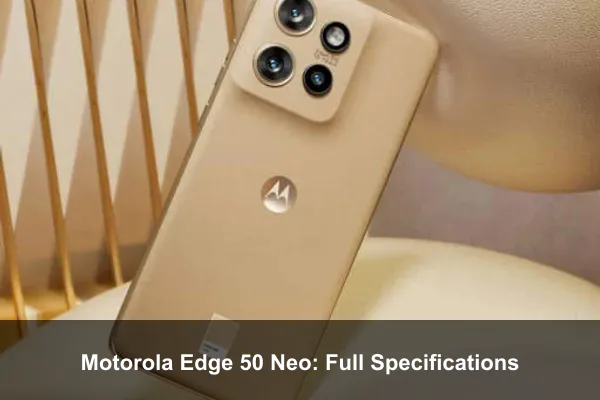
Motorola gives the Neo a versatile trio: a 50 MP f/1.8 wide with OIS and multi-directional PDAF, a 10 MP f/2.0 telephoto with 3x optical zoom and OIS, and a 13 MP ultrawide with autofocus that doubles for macro. The inclusion of a dedicated optical-zoom lens is rare in this class and meaningfully expands creative range compared with the usual wide-plus-ultrawide setups. Video tops out at 4K@30fps with gyro-EIS, while the 32 MP front camera also records 4K, making it a capable choice for selfies and vlogging.
Battery and Charging
A 4310 mAh cell sounds modest but the efficient chipset and LTPO display deliver an Active Use Score of 13:29h and a 50:44h EU endurance rating across 1200 charge cycles, indicating strong real-world stamina and longevity. Charging is generous for the segment: 68W wired refills quickly, and 15W wireless charging, often missing on compact mid-rangers, is included here.
Connectivity and Audio
The Neo covers the essentials and a bit more, with tri-band Wi-Fi 6e, Bluetooth 5.3, NFC, and multi-constellation GPS. Stereo speakers measured a clean -24.1 LUFS, rated very good, though there is no 3.5mm jack and the USB-C port is limited to 2.0 speeds. Motorola’s Smart Connect (Ready For) adds desktop-style productivity when paired with a larger screen.
Who Should Buy It
This phone is ideal for anyone hunting a true compact flagship-lite: one-handed users, frequent travelers who value durability, and buyers who want a telephoto camera and long software support without a large or heavy device. Gamers chasing peak frame rates or users who need fast wired data transfer should look elsewhere, but for everyone else the Edge 50 Neo is one of the most complete small phones available.
Conclusion
The Motorola Edge 50 Neo proves that small phones do not have to mean compromised phones. It blends a bright LTPO OLED, a genuinely versatile triple camera with optical zoom, rugged IP68 build, wireless charging, and a class-leading five-year update promise into a body that is light and easy to handle. The UFS 2.2 storage and midrange chipset are its only real concessions. If you want a durable, future-proofed compact phone that covers nearly every base, the Edge 50 Neo is an easy recommendation.
