
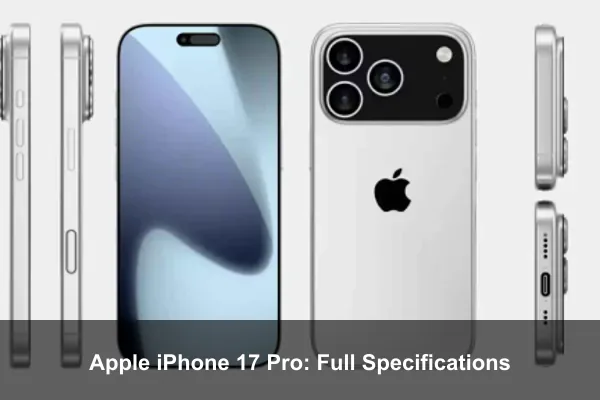
Apple iPhone 17 Pro appears as a rumored premium upgrade with a compact 6.3-inch form, a titanium frame, and Apple’s next-generation A19 Pro platform. It has not been officially announced, so final retail details may still change.
Rather than repeating the full specs table, this article focuses on what the listed hardware means in real use: ownership value, creator workflow potential, connectivity readiness, and who should consider it first.
Full Specifications
Network
| Technology: | GSM / CDMA / HSPA / EVDO / LTE / 5G |
| 2G bands: | GSM 850 / 900 / 1800 / 1900 |
| CDMA 800 / 1900 | |
| 3G bands: | HSDPA 850 / 900 / 1700(AWS) / 1900 / 2100 |
| CDMA2000 1xEV-DO | |
| 4G bands: | LTE |
| 5G bands: | SA/NSA/Sub6 |
| SA/NSA/Sub6/mmWave | |
| Speed: | HSPA, LTE, 5G, EV-DO Rev.A 3.1 Mbps |
Launch
| Announced: | Not announced yet |
| Status: | Rumored |
Body
| Dimensions: | – |
| Weight: | – |
| Build: | Glass front, glass back, titanium frame (grade 5) |
| SIM: | Nano-SIM + eSIM + eSIM (max 2 at a time; International)eSIM + eSIM (8 or more, max 2 at a time; USA)Nano-SIM + Nano-SIM (China) |
| IP68 dust tight and water resistant (immersible up to 6m for 30 min) Apple Pay (Visa, MasterCard, AMEX certified) |
Display
| Type: | LTPO Super Retina XDR OLED, 120Hz, HDR10, Dolby Vision |
| Size: | 6.3 inches, 97.2 cm2 |
| Resolution: | 1206 x 2622 pixels, 19.5:9 ratio (~458 ppi density) |
| Protection: | Ceramic Shield glass (2025 gen) |
Platform
| OS: | iOS 26 |
| Chipset: | Apple A19 Pro (3 nm) |
| CPU: | Hexa-core |
| GPU: | Apple GPU (6-core graphics) |
Memory
| Card slot: | No |
| Internal: | 256GB 12GB RAM, 512GB 12GB RAM, 1TB 12GB RAM |
| NVMe |
Main Camera
| Triple: | 48 MP, f/1.8, 24mm (wide), 1/1.28″, 1.22µm, dual pixel PDAF, sensor-shift OIS 48 MP, f/2.8, (periscope telephoto), 1/2.55″, 0.7µm, dual pixel PDAF, 3D sensor‑shift OIS, 5x optical zoom 48 MP, f/2.2, 13mm (ultrawide), 1/2.55″, 0.7µm, PDAF TOF 3D LiDAR scanner (depth) |
| Features: | Dual-LED dual-tone flash, HDR (photo/panorama) |
| Video: | 4K@24/25/30/60/100/120fps, 1080p@25/30/60/120/240fps, 10-bit HDR, Dolby Vision HDR (up to 60fps), ProRes, 3D (spatial) video/audio, stereo sound rec. |
Selfie camera
| Single: | 24 MP, f/1.9, 23mm (wide), PDAF, OIS SL 3D, (depth/biometrics sensor) |
| Features: | HDR, Dolby Vision HDR, 3D (spatial) audio, stereo sound rec. |
| Video: | 4K@24/25/30/60fps, 1080p@25/30/60/120fps, gyro-EIS |
Sound
| Loudspeaker: | Yes, with stereo speakers |
| 3.5mm jack: | No |
Comms
| WLAN: | Wi-Fi 802.11 a/b/g/n/ac/6e/7, tri-band, hotspot |
| Bluetooth: | 5.4, A2DP, LE |
| Positioning: | GPS (L1+L5), GLONASS, GALILEO, BDS, QZSS, NavIC |
| NFC: | Yes |
| Radio: | No |
| USB: | USB Type-C 3.2 Gen 2, DisplayPort |
Features
| Sensors: | Face ID, accelerometer, gyro, proximity, compass, barometer |
| Ultra Wideband (UWB) support (gen2 chip) Emergency SOS, Messages and Find My via satellite |
Battery
| Type: | Li-Ion |
| Charging: | Wired, PD2.0, 50% in 30 min 25W wireless (MagSafe), 15W wireless (China only) 15W wireless (Qi2) 4.5W reverse wired |
Misc
| Colors: | Black; other colors |
Value Positioning Before Official Pricing
With no confirmed price yet, value has to be judged from the hardware class: a 3 nm A19 Pro chip, 12GB RAM on every storage tier, and a triple 48MP rear camera system. On paper, it is positioned for users who prioritize premium capability over entry cost.
Design and Build Quality
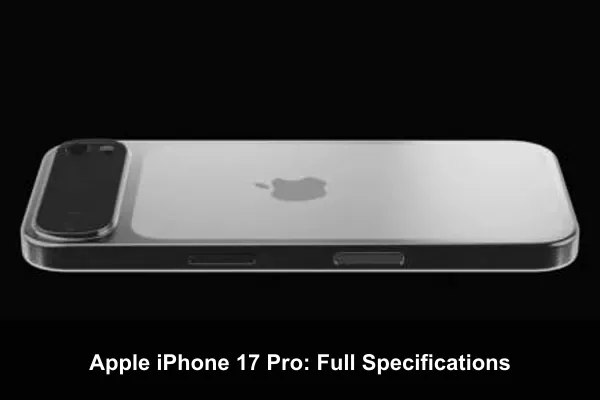
The listed grade 5 titanium frame with glass front and back keeps the Pro build direction intact. IP68 protection and Apple Pay support reinforce a daily-use flagship profile, even though dimensions and weight are still not listed.
Display Experience
A 6.3-inch LTPO Super Retina XDR OLED panel with 120Hz, HDR10, and Dolby Vision should deliver smooth motion and strong HDR playback. The 1206 x 2622 resolution (~458 ppi) and newer Ceramic Shield generation keep sharpness and screen durability competitive.
Performance and Storage Headroom
The A19 Pro plus hexa-core CPU setup is aimed at sustained performance for editing, gaming, and heavy multitasking. Storage starts at 256GB and scales to 1TB, all with 12GB RAM and NVMe, which is practical for high-bitrate video users.
Camera System for Creator Workflows
The rear configuration combines wide, ultrawide, and 5x periscope telephoto cameras, each at 48MP, with LiDAR depth support. Video options such as 4K up to 120fps, ProRes, Dolby Vision HDR, and spatial capture point to a strong hybrid photo-video toolset.
Battery and Charging Practicality
Battery capacity is still unspecified, but charging options are broad: wired PD2.0, MagSafe, Qi2, and reverse wired charging. The listed 50% in 30 minutes suggests Apple is targeting faster real-world top-ups rather than headline wattage alone.
Software and Daily Usability
iOS 26, Face ID, and UWB gen2 support should keep ecosystem integration strong for users already on Apple devices. Satellite features for Emergency SOS, Messages, and Find My add practical utility for travel and weak-network areas.
Connectivity and Future-Ready Hardware
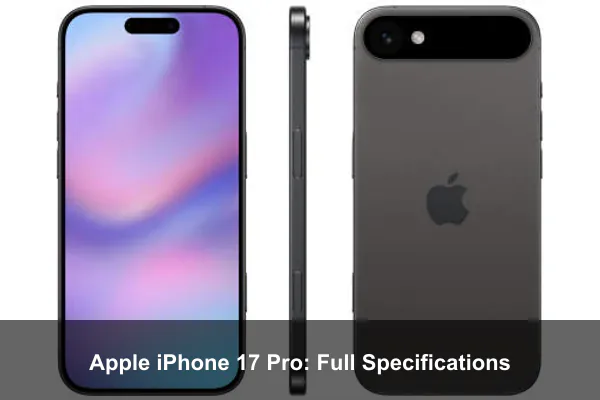
Support for SA/NSA/Sub6/mmWave 5G, Wi-Fi 7, Bluetooth 5.4, and USB-C 3.2 Gen 2 with DisplayPort gives the phone a high-end connectivity profile. This benefits users who rely on faster wireless standards and wired display or file transfer workflows.
Who Should Buy Apple iPhone 17 Pro?
This model fits users who want a relatively compact Pro iPhone with top-tier camera flexibility and modern connectivity. Buyers focused mainly on price efficiency should wait for official pricing and compare it against non-Pro and older Pro alternatives.
Conclusion
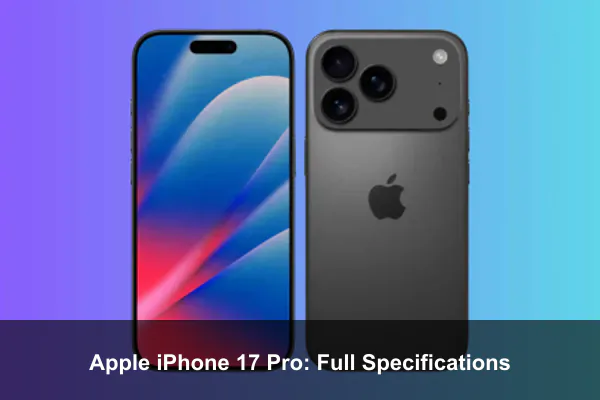
Apple iPhone 17 Pro looks like a creator-focused flagship with meaningful upgrades in display quality, imaging versatility, and connectivity; it is easy to shortlist, but the final recommendation depends on official launch pricing.
