
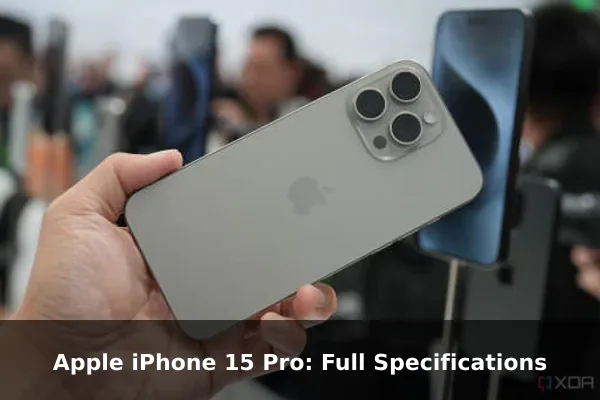
The Apple iPhone 15 Pro marked a turning point for Apple’s flagship line, swapping stainless steel for a grade 5 titanium frame and finally adopting USB-C in place of the Lightning port. Powered by the 3 nm A17 Pro chip and built around a 6.1-inch LTPO Super Retina XDR OLED panel, it packs the company’s most advanced compact hardware of its 2023 generation into a notably lighter 187 g body.
Announced on September 12, 2023 and released ten days later, the iPhone 15 Pro targets buyers who want a pocketable Pro device without stepping up to the larger Pro Max. This article breaks down what that hardware means in daily use, where the phone still holds up, and who should consider it today at its current price of roughly €720 / $645 / £604.80.
Full Specifications
Network
| Technology: | GSM / CDMA / HSPA / EVDO / LTE / 5G |
| 2G bands: | GSM 850 / 900 / 1800 / 1900 |
| CDMA 800 / 1900 | |
| 3G bands: | HSDPA 850 / 900 / 1700(AWS) / 1900 / 2100 |
| CDMA2000 1xEV-DO | |
| 4G bands: | 1, 2, 3, 4, 5, 7, 8, 12, 13, 17, 18, 19, 20, 25, 26, 28, 30, 32, 34, 38, 39, 40, 41, 42, 46, 48, 53, 66 – A3102 |
| 1, 2, 3, 4, 5, 7, 8, 12, 13, 14, 17, 18, 19, 20, 25, 26, 28, 29, 30, 32, 34, 38, 39, 40, 41, 42, 46, 48, 53, 66, 71 – A2848 | |
| 1, 2, 3, 4, 5, 7, 8, 11, 12, 13, 14, 17, 18, 19, 20, 21, 25, 26, 28, 29, 30, 32, 34, 38, 39, 40, 41, 42, 46, 48, 53, 66, 71 – A3101 | |
| 1, 2, 3, 4, 5, 7, 8, 12, 13, 17, 18, 19, 20, 25, 26, 28, 30, 32, 34, 38, 39, 40, 41, 42, 46, 48, 66 – A3104 | |
| 5G bands: | 1, 2, 3, 5, 7, 8, 12, 20, 25, 26, 28, 30, 38, 40, 41, 48, 53, 66, 70, 77, 78, 79 SA/NSA/Sub6 – A3102 |
| 1, 2, 3, 5, 7, 8, 12, 14, 20, 25, 26, 28, 29, 30, 38, 40, 41, 48, 53, 66, 70, 71, 77, 78, 79, 258, 260, 261 SA/NSA/Sub6/mmWave – A2848 | |
| 1, 2, 3, 5, 7, 8, 12, 14, 20, 25, 26, 28, 29, 30, 38, 40, 41, 48, 53, 66, 70, 71, 75, 76, 77, 78, 79 SA/NSA/Sub6 – A3101 | |
| 1, 2, 3, 5, 7, 8, 12, 20, 25, 26, 28, 30, 38, 40, 41, 48, 66, 70, 77, 78, 79 SA/NSA/Sub6 – A3104 | |
| Speed: | HSPA, LTE, 5G, EV-DO Rev.A 3.1 Mbps |
Launch
| Announced: | 2023, September 12 |
| Status: | Available. Released 2023, September 22 |
Body
| Dimensions: | 146.6 x 70.6 x 8.3 mm (5.77 x 2.78 x 0.33 in) |
| Weight: | 187 g (6.60 oz) |
| Build: | Glass front, glass back, titanium frame (grade 5) |
| SIM: | Nano-SIM + eSIM + eSIM (max 2 at a time; International)eSIM + eSIM (8 or more, max 2 at a time; USA)Nano-SIM + Nano-SIM (China) |
| IP68 dust tight and water resistant (immersible up to 6m for 30 min) Apple Pay (Visa, MasterCard, AMEX certified) |
Display
| Type: | LTPO Super Retina XDR OLED, 120Hz, HDR10, Dolby Vision, 1000 nits (typ), 2000 nits (HBM) |
| Size: | 6.1 inches, 91.3 cm2 (~88.2% screen-to-body ratio) |
| Resolution: | 1179 x 2556 pixels, 19.5:9 ratio (~461 ppi density) |
| Protection: | Ceramic Shield glass |
Platform
| OS: | iOS 17, upgradable to iOS 18.6 |
| Chipset: | Apple A17 Pro (3 nm) |
| CPU: | Hexa-core (2×3.78 GHz + 4×2.11 GHz) |
| GPU: | Apple GPU (6-core graphics) |
Memory
| Card slot: | No |
| Internal: | 128GB 8GB RAM, 256GB 8GB RAM, 512GB 8GB RAM, 1TB 8GB RAM |
| NVMe |
Main Camera
| Triple: | 48 MP, f/1.8, 24mm (wide), 1/1.28″, 1.22µm, dual pixel PDAF, sensor-shift OIS 12 MP, f/2.8, 77mm (telephoto), 1/3.5″, 1.0µm, PDAF, OIS, 3x optical zoom 12 MP, f/2.2, 13mm, 120˚ (ultrawide), 1/2.55″, 1.4µm, dual pixel PDAF TOF 3D LiDAR scanner (depth) |
| Features: | Dual-LED dual-tone flash, HDR (photo/panorama) |
| Video: | 4K@24/25/30/60fps, 1080p@25/30/60/120/240fps, 10-bit HDR, Dolby Vision HDR (up to 60fps), ProRes, 3D (spatial) video, stereo sound rec. |
Selfie camera
| Single: | 12 MP, f/1.9, 23mm (wide), 1/3.6″, 1.0µm, PDAF, OIS SL 3D, (depth/biometrics sensor) |
| Features: | HDR, Dolby Vision HDR |
| Video: | 4K@24/25/30/60fps, 1080p@25/30/60/120fps, gyro-EIS |
Sound
| Loudspeaker: | Yes, with stereo speakers |
| 3.5mm jack: | No |
Comms
| WLAN: | Wi-Fi 802.11 a/b/g/n/ac/6e, tri-band, hotspot |
| Bluetooth: | 5.3, A2DP, LE |
| Positioning: | GPS (L1+L5), GLONASS, GALILEO, BDS, QZSS, NavIC |
| NFC: | Yes |
| Radio: | No |
| USB: | USB Type-C 3.2 Gen 2, DisplayPort |
Features
| Sensors: | Face ID, accelerometer, gyro, proximity, compass, barometer |
| Ultra Wideband (UWB) support (gen2 chip) Emergency SOS, Messages and Find My via satellite |
Battery
| Type: | Li-Ion 3274 mAh |
| Charging: | Wired, PD2.0, 50% in 30 min 15W wireless (MagSafe) 15W wireless (Qi2) – requires iOS 17.2 update 4.5W reverse wired |
Misc
| Colors: | Black Titanium, White Titanium, Blue Titanium, Natural Titanium |
| Models: | A2848, A3101, A3102, A3104, iPhone16,1 |
| SAR: | 1.14 W/kg (head) 1.16 W/kg (body) |
| SAR EU: | 0.98 W/kg (head) 0.98 W/kg (body) |
| Price: | € 720.00 / $ 645.00 / £ 604.80 |
Our Tests
| Display: | 1786 nits max brightness (measured) |
| Camera: | Photo / Video |
| Loudspeaker: | -26.4 LUFS (Good) |
| Battery: | Active use score 12:58h |
| Battery (old): | Endurance rating 86h |
Price and Availability
The Apple iPhone 15 Pro offers a compelling combination of features and performance. While the base price is around €720, the actual cost may vary depending on your location and retailer. Below, you’ll find the approximate price of the Apple iPhone 15 Pro converted into various currencies. Please note that these are estimates based on recent exchange rates as of June 18, 2026 and may not reflect the exact price you’ll find at a retailer.
- United States: $832
- Japan: ¥133,459
- United Kingdom: £623
- Australia: A$1,181
- Canada: C$1,169
- Taiwan: NT$26,360
- Denmark: kr5.374
- Saudi Arabia: ﷼3,119
- South Korea: ₩1,264,876
- Germany: €720
- Brazil: R$4.240
- Vietnam: ₫21.791.981
- Kenya: KSh 108,170
- India: ₹78,771
- Indonesia: Rp 14.783.234
- Nigeria: ₦1,128,812
- Pakistan: ₨231,341
- Philippines: ₱50,387
- Bangladesh: ৳১,০২,০৮৪
Value: What You Get for the Money
At around €720 / $645 / £604.80, the iPhone 15 Pro sits in classic flagship territory, but its specification sheet explains the asking price. You get a titanium build, an A17 Pro chip fabricated on a 3 nm process, a 120Hz ProMotion OLED, a triple 48 MP-led camera system, and a future-proof USB-C 3.2 Gen 2 port with DisplayPort output. Compared with the standard iPhone 15, the Pro adds the always-on ProMotion display, the telephoto lens, the customizable Action button, and a substantially faster chipset, which is where most of the premium goes.
Design and Build Quality
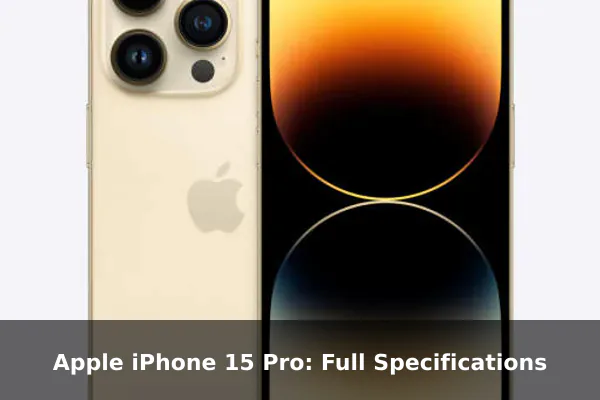
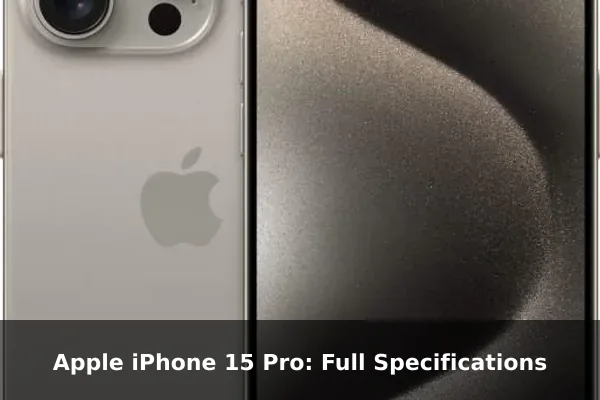
This is the first iPhone Pro to use a grade 5 titanium frame, and the weight savings are real: at 187 g and 146.6 x 70.6 x 8.3 mm, it is noticeably lighter than the steel-framed models it replaced. The glass front and back are paired with Ceramic Shield protection and an IP68 rating, with immersion resistance quoted up to 6 m for 30 minutes. Four muted finishes — Black, White, Blue, and Natural Titanium — lean understated rather than flashy. The new Action button, which replaces the mute switch, adds genuine practical flexibility for shortcuts.
Display: Compact but Bright

The 6.1-inch LTPO Super Retina XDR OLED runs at up to 120Hz and resolves 1179 x 2556 pixels (~461 ppi), with HDR10 and Dolby Vision support. Apple quotes 1000 nits typical and 2000 nits peak in high-brightness mode, and independent measurements pushed it close to 1786 nits, so outdoor legibility is excellent. The LTPO panel also enables the always-on display and adaptive refresh that drops to save power. For a compact flagship, this remains one of the better small screens you can buy.
Performance and Storage
The A17 Pro is the headline component, a 3 nm hexa-core chip (2×3.78 GHz + 4×2.11 GHz) paired with a 6-core GPU and 8GB of RAM. It introduced hardware-accelerated ray tracing to the iPhone and comfortably handles demanding games, ProRes capture, and multitasking. Storage spans 128GB, 256GB, 512GB, and 1TB on fast NVMe, with no microSD expansion — so choosing the right tier at purchase matters. Years after launch, this chip still feels quick for everyday tasks.
Camera System
The rear array combines a 48 MP f/1.8 wide with sensor-shift OIS, a 12 MP 3x telephoto, and a 12 MP ultrawide, supported by a LiDAR scanner for depth. The 48 MP sensor enables high-resolution and ProRAW shooting, while the system records 4K up to 60fps in 10-bit Dolby Vision HDR, plus ProRes and spatial video. The 12 MP f/1.9 front camera handles 4K selfies and Face ID. It is a versatile setup, though the 3x telephoto is shorter reach than the 5x found on that year’s larger Pro Max.
Battery and Charging
A 3274 mAh Li-Ion cell powers the phone, with wired PD2.0 charging rated to roughly 50% in 30 minutes, 15W MagSafe and Qi2 wireless, and 4.5W reverse wired. Real-world testing returned an active-use score of about 12 hours 58 minutes, which is solid for a compact device but not class-leading. Note that charging speeds and battery longevity can vary with conditions and software updates, so treat manufacturer figures as guidance rather than guarantees.
Software and Longevity
The iPhone 15 Pro shipped with iOS 17 and is upgradable to iOS 18.6, and Apple’s long support history means it should continue receiving updates for several more years. That software runway is a major part of its long-term value, keeping security patches and new features flowing well after rivals stop updating. Always confirm the latest supported iOS version on Apple’s official channels before buying, as support windows can change.
Connectivity
Connectivity is comprehensive: 5G with Sub6 and, on some models, mmWave, Wi-Fi 6e tri-band, Bluetooth 5.3, NFC, and a second-generation Ultra Wideband chip. The move to USB-C 3.2 Gen 2 brings faster data transfer and DisplayPort output, a meaningful upgrade for creators moving large ProRes files. Positioning covers GPS (L1+L5), GLONASS, Galileo, BDS, QZSS, and NavIC, and the phone adds Emergency SOS and Find My via satellite where available.
Who Should Buy the iPhone 15 Pro
This phone suits buyers who want a genuinely compact flagship with Pro-grade cameras, a 120Hz display, and a titanium build, but who do not need the Pro Max’s larger screen or longer telephoto. It is also a strong pick for anyone invested in the Apple ecosystem who values long software support and USB-C convenience. Heavy mobile photographers chasing maximum zoom or the longest battery life may prefer a larger or newer model.
Conclusion
The Apple iPhone 15 Pro remains a compelling compact flagship, blending a lightweight titanium design, a bright 120Hz OLED, the capable A17 Pro chip, a flexible triple-camera system, and the convenience of USB-C. Its main trade-offs are a modest battery capacity and a shorter telephoto reach than its Pro Max sibling. If you want top-tier iPhone performance in a one-handed form factor and value years of software updates, it is an easy recommendation — verify current pricing and the latest iOS support before you buy.
References
- Apple Support – iPhone 15 Pro Tech Specs – Primary source for iPhone 15 Pro specifications including dimensions, weight, display, chip, cameras, connectivity, charging, battery claims, sensors, storage, and model bands.
- Apple Newsroom – Apple unveils iPhone 15 Pro and iPhone 15 Pro Max – Official launch announcement for release context, key hardware changes, titanium design, A17 Pro, camera features, USB-C, and availability details.
- Apple Support – Identify your iPhone model – Official reference for confirming iPhone 15 Pro model numbers and distinguishing model details by region.
- Apple – iPhone Supported 5G and LTE Networks – Official source for regional cellular model compatibility and supported 5G/LTE bands.
- GSMArena – Apple iPhone 15 Pro – Established smartphone specifications database useful as a secondary cross-check, especially for fields Apple may not list directly such as RAM and battery capacity.
