
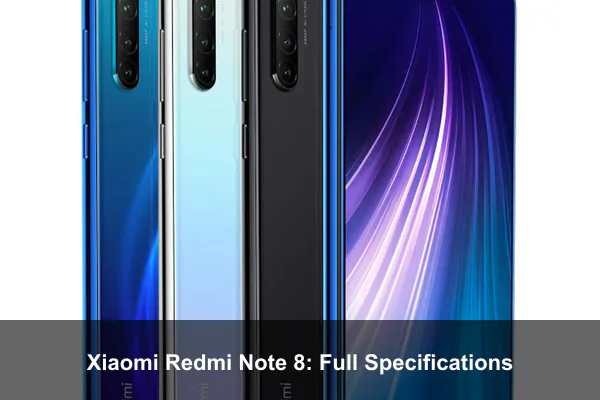
Xiaomi Redmi Note 8 was one of the defining budget phones of 2019, pairing a premium-style glass build with practical features that many affordable phones still skip. Although discontinued, it remains widely discussed in the used and backup-phone market.
This article uses a long-term value angle instead of repeating the raw spec sheet: what still feels competitive, what now feels dated, and where this phone fits for buyers in 2026.
Full Specifications
Network
| Technology | GSM / HSPA / LTE |
| 2G bands | GSM 850 / 900 / 1800 / 1900 |
| 3G bands | HSDPA 850 / 900 / 1700(AWS) / 1900 / 2100 |
| HSDPA 850 / 900 / 2100 | |
| 4G bands | 1, 2, 3, 4, 5, 7, 8, 20, 38, 40 |
| 1, 3, 5, 8, 38, 40, 41 | |
| Speed | HSPA 42.2/5.76 Mbps, LTE (4CA) Cat12 600/50 Mbps |
Launch
| Announced | 2019, August 29. Released 2019, October 16 |
| Status | Discontinued |
Body
| Dimensions | 158.3 x 75.3 x 8.4 mm (6.23 x 2.96 x 0.33 in) |
| Weight | 190 (6.70 oz) |
| Build | Glass front (Gorilla Glass 5), glass back (Gorilla Glass 5), plastic frame |
| SIM | Nano-SIM + Nano-SIM |
Display
| Type | IPS LCD |
| Size | 6.3 inches, 97.4 cm2 (~81.7% screen-to-body ratio) |
| Resolution | 1080 x 2340 pixels, 19.5:9 ratio (~409 ppi density) |
| Protection | Corning Gorilla Glass 5 |
Platform
| OS | Android 9.0 (Pie), upgradable to Android 11, MIUI 12.5 |
| Chipset | Qualcomm SDM665 Snapdragon 665 (11 nm) |
| CPU | Octa-core (4×2.0 GHz Kryo 260 Gold & 4×1.8 GHz Kryo 260 Silver) |
| GPU | Adreno 610 |
Memory
| Card slot | microSDXC (dedicated slot) |
| Internal | 32GB 3GB RAM, 64GB 4GB RAM, 64GB 6GB RAM, 128GB 4GB RAM, 128GB 6GB RAM |
| eMMC 5.1 |
Main Camera
| Quad | 48 MP, f/1.8, 26mm (wide), 1/2.0", 0.8µm, PDAF 8 MP, f/2.2, 120˚ (ultrawide), 1/4.0", 1.12µm 2 MP (macro) Auxiliary lens |
| Features | LED flash, HDR, panorama |
| Video | 4K@30fps, 1080p@30/60/120fps; gyro-EIS |
Selfie camera
| Single | 13 MP, f/2.0, (wide), 1/3.1", 1.12µm |
| Features | HDR, panorama |
| Video | 1080p@30fps |
Sound
| Loudspeaker | Yes |
| 3.5mm jack | Yes |
Comms
| WLAN | Wi-Fi 802.11 a/b/g/n/ac, dual-band, Wi-Fi Direct |
| Bluetooth | 4.2, A2DP, LE |
| Positioning | GPS, GLONASS, BDS |
| NFC | No |
| Infrared port | Yes |
| Radio | FM radio |
| USB | USB Type-C 2.0, OTG |
Features
| Sensors | Fingerprint (rear-mounted), accelerometer, gyro, proximity, compass |
Battery
| Type | Li-Po 4000 mAh, non-removable |
| Charging | 18W wired |
Misc
| Colors | Neptune Blue, Moonlight White, Space Black, Nebula Purple, Cosmic Purple |
| Models | M1908C3JH, M1908C3JG, M1908C3JI |
| SAR | 0.26 W/kg (head) 1.00 W/kg (body) |
| SAR EU | 0.19 W/kg (head) 1.09 W/kg (body) |
| Price | About 220 EUR |
Our Tests
| Performance | AnTuTu: 141915 (v7), 161572 (v8) GeekBench: 5590 (v4.4), 1339 (v5.1) GFXBench: 5.9fps (ES 3.1 onscreen) |
| Display | Contrast ratio: 1521:1 (nominal) |
| Camera | Photo / Video |
| Loudspeaker | Voice 78dB / Noise 72dB / Ring 81dB |
| Audio quality | Noise -94.0dB / Crosstalk -93.3dB |
| Battery (old) | Endurance rating 108h |
Price and Availability
The Xiaomi Redmi Note 8 offers a compelling combination of features and performance. While the base price is around €220, the actual cost may vary depending on your location and retailer. Below, you’ll find the approximate price of the Xiaomi Redmi Note 8 converted into various currencies. Please note that these are estimates based on recent exchange rates as of April 13, 2026 and may not reflect the exact price you’ll find at a retailer.
- United States: $257
- Japan: ¥41,029
- United Kingdom: £192
- Australia: A$366
- Canada: C$356
- Taiwan: NT$8,171
- Denmark: kr1.641
- Saudi Arabia: ﷼964
- South Korea: ₩382,187
- Germany: €220
- Brazil: R$1.291
- Vietnam: ₫6.716.022
- Kenya: KSh 33,293
- India: ₹23,889
- Indonesia: Rp 4.390.705
- Nigeria: ₦351,194
- Pakistan: ₨72,135
- Philippines: ₱15,391
- Bangladesh: ৳৩১,৫৭১
Value in 2026
Redmi Note 8 is best viewed as a low-cost secondary phone rather than a modern primary device. It still offers a strong hardware mix for basic tasks, especially if found well below its original about-220-EUR class. Compared with newer budget phones, the trade-off is clear: lower cost versus older software and no 5G.
Design and Build Quality
The glass front and back with Gorilla Glass 5 still give it a more premium feel than many entry models that use full plastic shells. At 190 g and 8.4 mm thick, it feels solid in hand, and the rear fingerprint reader remains practical for everyday unlocking.
Display Experience
The 6.3-inch IPS LCD panel has Full HD+ resolution, so text and icons remain sharp for browsing and video. In testing, the 1521:1 contrast result is respectable for an LCD in this segment. It is not an HDR-focused panel, but it is still comfortable for daily media and social apps.
Performance for Daily Apps
Snapdragon 665 with Adreno 610 is tuned for stable everyday use, not high-end gaming. The benchmark figures place it in an older mid-range tier that can still handle messaging, navigation, streaming, and light multitasking. eMMC 5.1 storage also means slower app installs and loading than modern UFS-based phones.
Camera System Practicality
The 48 MP main camera plus ultrawide gives useful flexibility in good lighting, while 4K recording and gyro-EIS at 1080p help for casual video capture. The 13 MP selfie camera is adequate for calls and social uploads. As with most older multi-camera setups, low-light output and secondary lenses are the first compromises versus newer models.
Battery Life and Charging
A 4000 mAh battery and efficient chipset still produce dependable endurance for moderate users. The recorded 108-hour endurance rating explains why this model earned a strong battery reputation. Charging is limited to 18W, so top-ups are noticeably slower than current fast-charging standards.
Software and Long-Term Support
The phone shipped with Android 9 and tops out at Android 11 with MIUI 12.5. That software ceiling is the main long-term limitation today, especially for users who prioritize newer Android features and extended update coverage. Core apps still run, but long-horizon usability is better on newer Redmi generations.
Connectivity and Useful Extras
For a 4G device, connectivity is well-rounded: LTE Cat12 with carrier aggregation, dual-band Wi-Fi ac, USB-C with OTG, and dual SIM support. Practical extras like a 3.5 mm jack, FM radio, dedicated microSD slot, and infrared port remain genuinely useful. The key omissions by current standards are NFC and 5G.
Who Should Buy Xiaomi Redmi Note 8?
This phone still makes sense for students, light users, or anyone needing a dependable backup handset at the right used-market price. It is also a fit for users who prioritize headphone jack plus microSD flexibility over cutting-edge speed. Power users, mobile gamers, and buyers wanting long software life should target newer Redmi or Poco alternatives.
Conclusion
Xiaomi Redmi Note 8 remains a practical legacy budget phone with balanced basics, but its aging software and lack of 5G define its limits. Recommendation: buy it only as a low-cost secondary device; for a main phone, a newer model is the smarter choice.
