
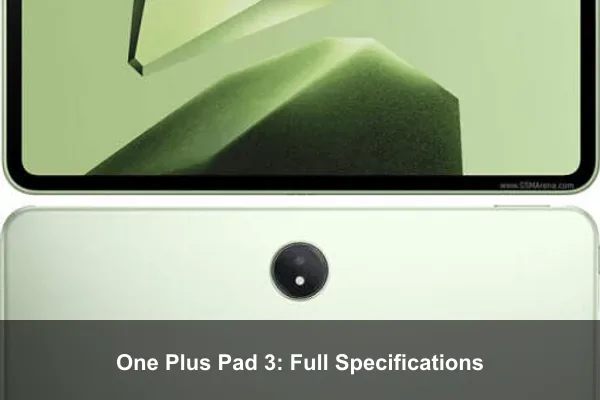
One Plus Pad 3 is aimed at buyers who want a large Android tablet for work, study, and streaming without moving into laptop-tier prices. Announced on June 5, 2025, and released on June 19, 2025, it enters the market at about 600 EUR.
Its positioning is clear: prioritize a big high-refresh screen, flagship-level chipset, strong audio, and fast charging over phone-like extras. That makes it a better comparison against productivity tablets than against standard smartphones.
Full Specifications
Network
| Technology: | No cellular connectivity |
| 2G bands: | N/A |
| 3G bands: | N/A |
| 4G bands: | N/A |
| GPRS: | No |
| EDGE: | No |
Launch
| Announced: | 2025, June 05 |
| Status: | Available. Released 2025, June 19 |
Body
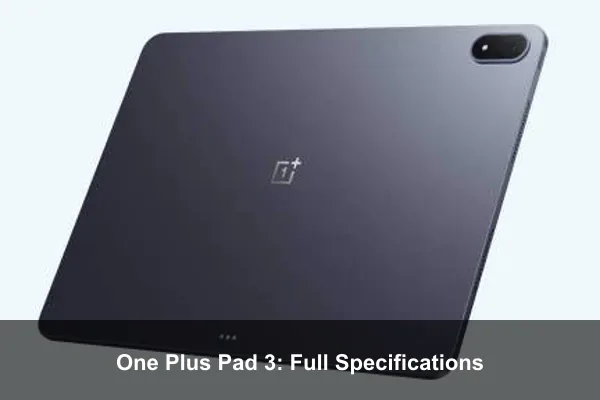
| Dimensions: | 289.6 x 209.7 x 6 mm (11.40 x 8.26 x 0.24 in) |
| Weight: | 675 g (1.49 lb) |
| Build: | Glass front, aluminum frame, aluminum back |
| SIM: | No |
| Stylus support |
Display
| Type: | IPS LCD, 68B colors, Dolby Vision, 144Hz, 900 nits (HBM) |
| Size: | 13.2 inches, 530.0 cm2 (~87.3% screen-to-body ratio) |
| Resolution: | 2400 x 3392 pixels (~315 ppi density) |
Platform
| OS: | Android 15, ColorOS 15 |
| Chipset: | Qualcomm SM8750-AB Snapdragon 8 Elite (3 nm) |
| CPU: | Octa-core (2×4.32 GHz Oryon V2 Phoenix L + 6×3.53 GHz Oryon V2 Phoenix M) |
| GPU: | Adreno 830 |
Memory
| Card slot: | No |
| Internal: | 256GB 12GB RAM, 512GB 16GB RAM |
| UFS 4.0 |
Main Camera
| Single: | 13 MP |
| Features: | Color spectrum sensor, LED flash |
| Video: | 4K@30fps, 1080p@30ps, gyro-EIS |
Selfie camera
| Single: | 8 MP |
| Video: | 1080p@30fps |
Sound
| Loudspeaker: | Yes, with stereo speakers (8 speakers) |
| 3.5mm jack: | No |
| 24-bit/192kHz audio |
Comms
| WLAN: | Wi-Fi 802.11 a/b/g/n/ac/6/7, dual-band |
| Bluetooth: | 5.4, A2DP, LE, aptX HD |
| Positioning: | No |
| NFC: | No |
| Radio: | No |
| USB: | USB Type-C 3.2, OTG, accessory connector |
Features
| Sensors: | Accelerometer, proximity (accessories only), gyro, compass |
Battery
| Type: | 12140 mAh |
| Charging: | 80W wired |
Misc
| Colors: | Storm Blue |
| Models: | OPD2415 |
| Price: | About 600 EUR |
Our Tests
| Loudspeaker: | -23.6 LUFS (Very good) |
| Battery: | Active use score 10:49h |
Price and Availability
The One Plus Pad 3 offers a compelling combination of features and performance. While the base price is around €600, the actual cost may vary depending on your location and retailer. Below, you’ll find the approximate price of the One Plus Pad 3 converted into various currencies. Please note that these are estimates based on recent exchange rates as of April 8, 2026 and may not reflect the exact price you’ll find at a retailer.
- United States: $697
- Japan: ¥111,059
- United Kingdom: £524
- Australia: A$998
- Canada: C$968
- Taiwan: NT$22,139
- Denmark: kr4.478
- Saudi Arabia: ﷼2,614
- South Korea: ₩1,040,578
- Germany: €600
- Brazil: R$3.575
- Vietnam: ₫18.313.454
- Kenya: KSh 90,188
- India: ₹64,481
- Indonesia: Rp 11.828.111
- Nigeria: ₦956,715
- Pakistan: ₨194,965
- Philippines: ₱41,814
- Bangladesh: ৳৮৫,৩৭৭
Value at Around 600 EUR
At its price point, the One Plus Pad 3 stands out by combining a Snapdragon 8 Elite platform, up to 16GB RAM, UFS 4.0 storage, and an oversized 13.2-inch panel. Compared with many midrange tablets, it spends more of the budget on performance and display quality, which is where long-term value usually matters most.
Design and Build Quality
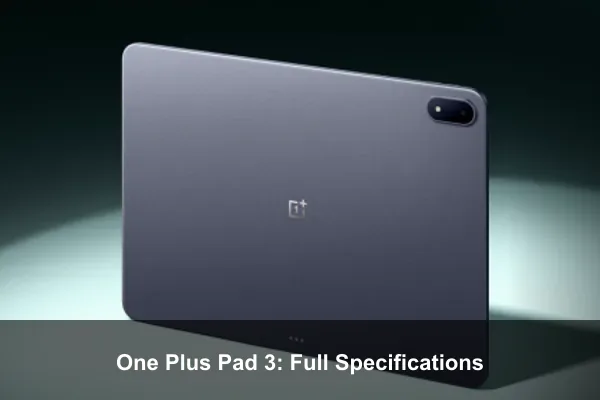
The chassis is thin at 6 mm and uses a glass front with an aluminum frame and back, giving it a premium feel for a large-format tablet. Stylus support also strengthens its role for note-taking and sketching, while the 675 g weight is reasonable for this screen class.
Display for Work and Media
The 13.2-inch IPS LCD is the core experience: 2400 x 3392 resolution, 144Hz refresh rate, Dolby Vision support, and up to 900 nits in high brightness mode. In practical use, this setup is better suited for multitasking and video than smaller tablet panels, especially for split-view workflows.
Performance and Storage Headroom
With the 3 nm Snapdragon 8 Elite, octa-core Oryon CPU, and Adreno 830 GPU, this tablet targets near-flagship Android performance. The 12GB/256GB and 16GB/512GB options provide enough headroom for heavy apps and larger files, though there is no microSD expansion.
Camera Setup in Real Usage
The cameras are functional rather than a buying highlight: 13MP rear with LED flash and color spectrum sensor, plus an 8MP front camera for calls. Video support up to 4K at 30fps on the main camera is solid for document capture and occasional recording, but this is not a camera-first device.
Battery Life and Charging Speed
A 12140 mAh battery paired with 80W wired charging supports long sessions and faster top-ups than many large tablets. The reported active use score of 10:49h indicates dependable endurance for mixed daily workloads instead of short burst use.
Software Experience
Running Android 15 with ColorOS 15, the One Plus Pad 3 is positioned for modern app compatibility and current UI features. Buyers should treat software polish and update longevity as key comparison points versus other brands in this price tier.
Connectivity and Audio Tradeoffs
Connectivity is strong on local wireless standards with Wi-Fi 7 and Bluetooth 5.4 with aptX HD, plus USB Type-C 3.2, OTG, and an accessory connector. The tradeoff is clear: no cellular modem, no GPS, and no NFC, so it is best used as a Wi-Fi-first tablet. Audio is a strength, with an 8-speaker stereo system and a very good loudspeaker test result.
Who Should Buy One Plus Pad 3
This model is best for users who want a big-screen Android tablet for productivity, media, and accessories like a stylus, while staying around the 600 EUR class. If you need always-on mobile data or navigation hardware, you should look at LTE or 5G tablet alternatives instead.
Conclusion
One Plus Pad 3 delivers a strong large-tablet package with a fast chipset, high-refresh display, capable battery system, and excellent speaker setup; it is an easy recommendation for Wi-Fi-first power users.
