
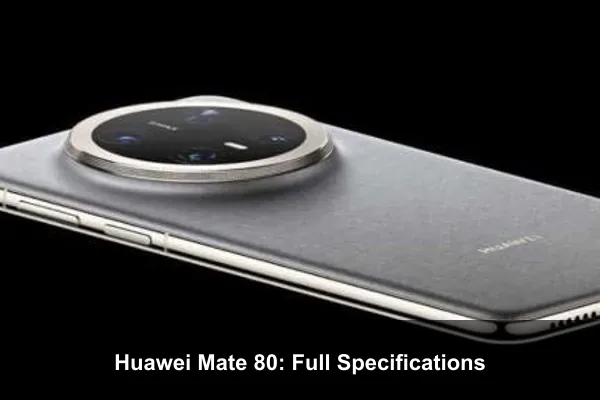
The Huawei Mate 80 is a premium HarmonyOS flagship built around a large LTPO OLED display, a Kirin 9020 chipset, and a triple rear camera system with periscope zoom.
Its strongest angle is durability: Huawei combines Kunlun Glass 2, an aluminum alloy frame, IP68/IP69 protection, and a sizeable 5750 mAh battery for heavy daily use.
Full Specifications
Network
| Technology: | GSM / CDMA / HSPA / CDMA2000 / LTE / 5G |
| 2G bands: | GSM 850 / 900 / 1800 / 1900 |
| CDMA 800 | |
| 3G bands: | HSDPA 800 / 850 / 900 / 1700(AWS) / 1900 / 2100 |
| CDMA2000 1x | |
| 4G bands: | LTE |
| 5G bands: | SA/NSA |
| Speed: | HSPA, LTE, 5G |
Launch
| Announced: | 2025, November 25 |
| Status: | Available. Released 2025, November 25 |
Body
| Dimensions: | 161.9 x 76 x 8 mm (6.37 x 2.99 x 0.31 in) |
| Weight: | 217 g (7.65 oz) |
| Build: | Glass front, aluminum alloy frame, fiber-reinforced plastic back |
| SIM: | Nano-SIM + Nano-SIM |
| IP68/IP69 dust tight and water resistant (high pressure water jets; immersible up to 6m for 30 min) |
Display
| Type: | LTPO OLED, 1B colors, 120Hz, 1440Hz PWM, HDR Vivid |
| Size: | 6.75 inches, 110.3 cm2 (~89.7% screen-to-body ratio) |
| Resolution: | 1280 x 2832 pixels (~460 ppi density) |
| Protection: | Huawei Kunlun Glass 2 |
Platform
| OS: | HarmonyOS 6.0 |
| Chipset: | Kirin 9020 (7 nm) |
| CPU: | Octa-core (1×2.5 GHz & 3×2.15 GHz & 4×1.6 GHz) |
| GPU: | Maleoon 920 |
Memory
| Card slot: | No |
| Internal: | 256GB 12GB RAM, 512GB 12GB RAM, 512GB 16GB RAM |
Main Camera
| Triple: | 50 MP, f/1.4-f/4.0, 24mm (wide), PDAF, OIS 12 MP, f/3.4, 125mm (periscope telephoto), PDAF, OIS, 5.5x optical zoom 40 MP, f/2.2, 13mm, 120˚ (ultrawide), PDAF |
| Features: | Laser AF, color spectrum sensor, LED flash, panorama, HDR |
| Video: | 4K, 1080p@240fps, HDR, gyro-EIS, OIS, HDR Vivid |
Selfie camera
| Single: | 13 MP, f/2.0, 18mm (ultrawide), AF TOF 3D, (depth/biometrics sensor) |
| Features: | HDR, panorama |
| Video: | 4K, 1080p, HDR, gyro-EIS |
Sound
| Loudspeaker: | Yes, with stereo speakers |
| 3.5mm jack: | No |
| High-definition audio |
Comms
| WLAN: | Wi-Fi 802.11 a/b/g/n/ac/6/7, dual-band, Wi-Fi Direct |
| Bluetooth: | 6.0, A2DP, LE, L2HC |
| Positioning: | GPS (L1+L5), GLONASS (L1), BDS (B1I+B1c+B2a+B2b), GALILEO (E1+E5a+E5b), QZSS (L1+L5), NavIC |
| NFC: | Yes |
| Infrared port: | Yes |
| Radio: | No |
| USB: | USB Type-C 3.1, OTG, DisplayPort 1.2 |
Features
| Sensors: | Face ID, fingerprint (side-mounted), accelerometer, gyro, proximity, barometer, compass |
| BDS Satellite Calling and Messaging – China only |
Battery
| Type: | 5750 mAh |
| Charging: | 66W wired 50W wireless Reverse wireless 5W reverse wired |
Misc
| Colors: | Black, White, Green, Gold |
| Models: | VYG-AL00 |
| Price: | About 570 EUR |
Price and Availability
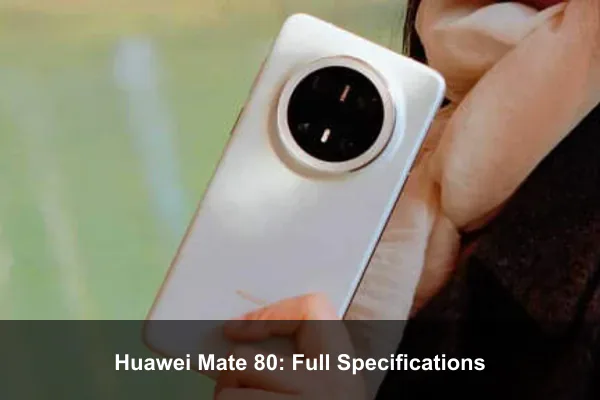
The Huawei Mate 80 offers a compelling combination of features and performance. While the base price is around €570, the actual cost may vary depending on your location and retailer. Below, you’ll find the approximate price of the Huawei Mate 80 converted into various currencies. Please note that these are estimates based on recent exchange rates as of May 11, 2026 and may not reflect the exact price you’ll find at a retailer.
- United States: $671
- Japan: ¥105,183
- United Kingdom: £493
- Australia: A$927
- Canada: C$918
- Taiwan: NT$21,006
- Denmark: kr4.253
- Saudi Arabia: ﷼2,515
- South Korea: ₩981,929
- Germany: €570
- Brazil: R$3.287
- Vietnam: ₫17.569.766
- Kenya: KSh 86,562
- India: ₹63,361
- Indonesia: Rp 11.649.275
- Nigeria: ₦909,901
- Pakistan: ₨186,906
- Philippines: ₱40,598
- Bangladesh: ৳৮২,৪১০
Why Should You Buy the Huawei Mate 80?
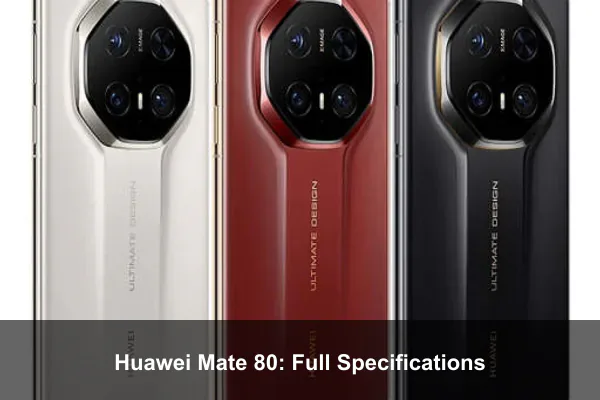
The Mate 80 targets buyers who want a flagship-style Huawei phone with a high-resolution OLED screen, strong ingress protection, long battery capacity, wireless charging, and a versatile camera setup. At the listed source price, its value depends heavily on whether HarmonyOS and Huawei’s app ecosystem fit your region and workflow.
Design and Durability
Huawei gives the Mate 80 a glass front, aluminum alloy frame, and fiber-reinforced plastic back. The 217 g weight makes it a substantial phone, but the IP68/IP69 rating, including high-pressure water resistance and immersion up to 6 meters for 30 minutes, is a clear advantage for durability-focused users.
Display Quality
The 6.75-inch LTPO OLED panel is one of the main highlights. It offers 1B colors, a 120Hz refresh rate, HDR Vivid support, 1440Hz PWM dimming, and a sharp 1280 x 2832 resolution at about 460 ppi, making it well suited for video, reading, and high-refresh everyday use.
Performance and Storage
The Kirin 9020 chipset is paired with an octa-core CPU and Maleoon 920 GPU. Storage options go up to 512GB with either 12GB or 16GB of RAM, but there is no memory card slot, so buyers should choose the storage variant carefully from the start.
Camera System
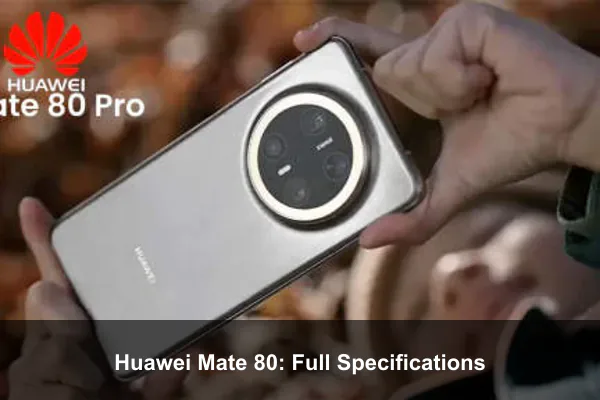
The rear camera setup is flexible, with a 50 MP variable-aperture wide camera, a 12 MP periscope telephoto camera with 5.5x optical zoom, and a 40 MP ultrawide camera. Laser autofocus, a color spectrum sensor, OIS, HDR Vivid video, and 4K recording give it a strong imaging feature set on paper.
Selfie and Video Features
The front camera uses a 13 MP ultrawide sensor with autofocus, joined by a TOF 3D depth and biometrics sensor. It supports HDR, panorama, 4K video, 1080p video, and gyro-EIS, which helps make the Mate 80 more useful for video calls, wide selfies, and handheld recording.
Battery and Charging
The 5750 mAh battery is a major practical strength. Charging support includes 66W wired, 50W wireless, reverse wireless charging, and 5W reverse wired charging, giving the Mate 80 more flexibility than phones that only focus on wired charging speed.
Software and Connectivity
The phone runs HarmonyOS 6.0 and supports 5G, Wi-Fi 7, Bluetooth 6.0, NFC, infrared, USB-C 3.1, OTG, and DisplayPort 1.2. Its satellite calling and messaging feature is listed for China only, so international buyers should treat that as a region-limited extra rather than a universal feature.
Who Should Buy It?
The Huawei Mate 80 is best for users who prioritize screen quality, durability, battery life, camera range, and Huawei ecosystem features. It is less ideal for buyers who need Google-centric services out of the box or expandable storage.
Conclusion
The Huawei Mate 80 is a strong durability-first flagship with a sharp LTPO OLED display, capable cameras, a large battery, and broad connectivity. It is easy to recommend for Huawei ecosystem users who want a premium all-rounder.
