
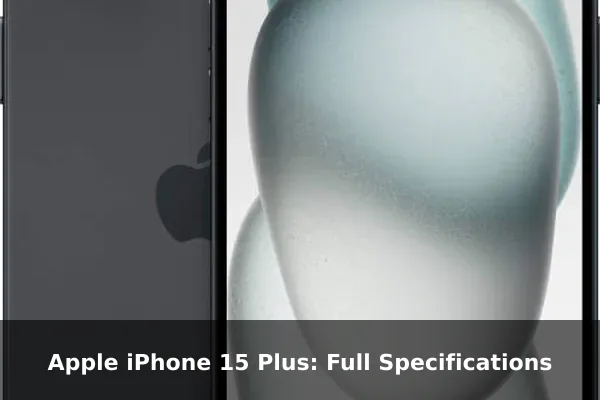
The Apple iPhone 15 Plus arrived in September 2023 as the large-screen alternative to the standard iPhone 15, pairing a 6.7-inch Super Retina XDR OLED panel with the A16 Bionic chip carried over from the previous Pro line. According to Apple’s official launch materials, it was the first Plus model to ship with USB Type-C, a Dynamic Island, and a 48 MP main camera, making it a meaningful step up from the iPhone 14 Plus while sitting below the iPhone 15 Pro Max in Apple’s 2023 lineup.
This breakdown looks at the iPhone 15 Plus through a value-and-longevity lens rather than as a brand-new flagship. With iOS 18.6 support, a 4383 mAh battery, and a refined titanium-adjacent aluminum-and-glass build, it has aged into a calmer mid-cycle pick for buyers who want a roomy iPhone without paying ProMotion or telephoto premiums.
Full Specifications
Network
| Technology: | GSM / CDMA / HSPA / EVDO / LTE / 5G |
| 2G bands: | GSM 850 / 900 / 1800 / 1900 |
| CDMA 800 / 1900 | |
| 3G bands: | HSDPA 850 / 900 / 1700(AWS) / 1900 / 2100 |
| CDMA2000 1xEV-DO | |
| 4G bands: | 1, 2, 3, 4, 5, 7, 8, 12, 13, 17, 18, 19, 20, 25, 26, 28, 30, 32, 34, 38, 39, 40, 41, 42, 46, 48, 53, 66 – A3094 |
| 1, 2, 3, 4, 5, 7, 8, 12, 13, 14, 17, 18, 19, 20, 25, 26, 28, 29, 30, 32, 34, 38, 39, 40, 41, 42, 46, 48, 53, 66, 71 – A2847 | |
| 1, 2, 3, 4, 5, 7, 8, 11, 12, 13, 14, 17, 18, 19, 20, 21, 25, 26, 28, 29, 30, 32, 34, 38, 39, 40, 41, 42, 46, 48, 53, 66, 71 – A3093 | |
| 1, 2, 3, 4, 5, 7, 8, 12, 13, 17, 18, 19, 20, 25, 26, 28, 30, 32, 34, 38, 39, 40, 41, 42, 46, 48, 66 – A3096 | |
| 5G bands: | 1, 2, 3, 5, 7, 8, 12, 20, 25, 26, 28, 30, 38, 40, 41, 48, 53, 66, 70, 77, 78, 79 SA/NSA/Sub6 – A3094 |
| 1, 2, 3, 5, 7, 8, 12, 14, 20, 25, 26, 28, 29, 30, 38, 40, 41, 48, 53, 66, 70, 71, 77, 78, 79, 258, 260, 261 SA/NSA/Sub6/mmWave – A2847 | |
| 1, 2, 3, 5, 7, 8, 12, 14, 20, 25, 26, 28, 29, 30, 38, 40, 41, 48, 53, 66, 70, 71, 75, 76, 77, 78, 79 SA/NSA/Sub6 – A3093 | |
| 1, 2, 3, 5, 7, 8, 12, 20, 25, 26, 28, 30, 38, 40, 41, 48, 66, 70, 77, 78, 79 SA/NSA/Sub6 – A3096 | |
| Speed: | HSPA, LTE, 5G, EV-DO Rev.A 3.1 Mbps |
Launch
| Announced: | 2023, September 12 |
| Status: | Available. Released 2023, September 22 |
Body
| Dimensions: | 160.9 x 77.8 x 7.8 mm (6.33 x 3.06 x 0.31 in) |
| Weight: | 201 g (7.09 oz) |
| Build: | Glass front, glass back, aluminum frame |
| SIM: | Nano-SIM + eSIM + eSIM (max 2 at a time; International)eSIM + eSIM (8 or more, max 2 at a time; USA)Nano-SIM + Nano-SIM (China) |
| IP68 dust tight and water resistant (immersible up to 6m for 30 min) Apple Pay (Visa, MasterCard, AMEX certified) |
Display
| Type: | Super Retina XDR OLED, HDR10, Dolby Vision, 1000 nits (HBM), 2000 nits (peak) |
| Size: | 6.7 inches, 110.2 cm2 (~88.0% screen-to-body ratio) |
| Resolution: | 1290 x 2796 pixels, 19.5:9 ratio (~460 ppi density) |
| Protection: | Ceramic Shield glass |
Platform
| OS: | iOS 17, upgradable to iOS 18.6 |
| Chipset: | Apple A16 Bionic (4 nm) |
| CPU: | Hexa-core (2×3.46 GHz Everest + 4×2.02 GHz Sawtooth) |
| GPU: | Apple GPU (5-core graphics) |
Memory
| Card slot: | No |
| Internal: | 128GB 6GB RAM, 256GB 6GB RAM, 512GB 6GB RAM |
| NVMe |
Main Camera
| Dual: | 48 MP, f/1.6, 26mm (wide), 1/1.56″, 1.0µm, dual pixel PDAF, sensor-shift OIS 12 MP, f/2.4, 13mm, 120˚ (ultrawide), 0.7µm |
| Features: | Dual-LED dual-tone flash, HDR (photo/panorama) |
| Video: | 4K@24/25/30/60fps, 1080p@25/30/60/120/240fps, HDR, Dolby Vision HDR (up to 60fps), stereo sound rec. |
Selfie camera
| Single: | 12 MP, f/1.9, 23mm (wide), 1/3.6″, 1.0µm, PDAF SL 3D, (depth/biometrics sensor) |
| Features: | HDR, Dolby Vision HDR |
| Video: | 4K@24/25/30/60fps, 1080p@25/30/60/120fps, gyro-EIS |
Sound
| Loudspeaker: | Yes, with stereo speakers |
| 3.5mm jack: | No |
Comms
| WLAN: | Wi-Fi 802.11 a/b/g/n/ac/6, dual-band, hotspot |
| Bluetooth: | 5.3, A2DP, LE |
| Positioning: | GPS, GLONASS, GALILEO, BDS, QZSS |
| NFC: | Yes |
| Radio: | No |
| USB: | USB Type-C 2.0, DisplayPort |
Features
| Sensors: | Face ID, accelerometer, gyro, proximity, compass, barometer |
| Ultra Wideband (UWB) support (gen2 chip) Emergency SOS, Messages and Find My via satellite |
Battery
| Type: | Li-Ion 4383 mAh |
| Charging: | Wired, PD2.0, 50% in 30 min 15W wireless (MagSafe) 15W wireless (Qi2) – requires iOS 17.2 update 4.5W reverse wired |
Misc
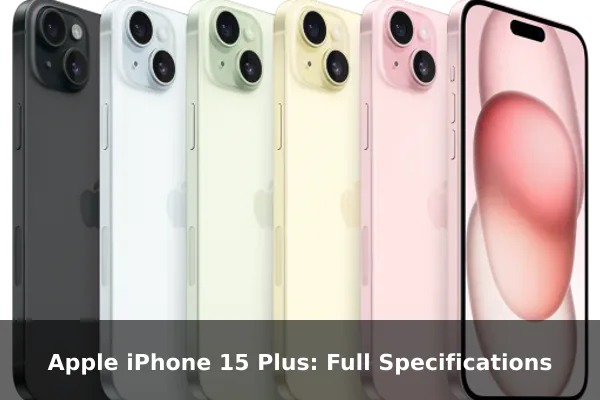
| Colors: | Black, Blue, Green, Yellow, Pink |
| Models: | A3094, A2847, A3093, A3096, iPhone15,5 |
| SAR: | 1.01 W/kg (head) 1.12 W/kg (body) |
| SAR EU: | 0.98 W/kg (head) 0.98 W/kg (body) |
| Price: | € 678.40 / $ 527.00 / £ 514.19 / ₹ 82,900 |
Our Tests
| Performance: | AnTuTu: 1385649 (v10) GeekBench: 6618 (v6) GFXBench: 60fps (ES 3.1 onscreen) |
| Display: | 1642 nits max brightness (measured) |
| Camera: | Photo / Video |
| Loudspeaker: | -27.7 LUFS (Good) |
| Battery: | Active use score 16:33h |
| Battery (old): | Endurance rating 111h |
Price and Availability
The Apple iPhone 15 Plus offers a compelling combination of features and performance. While the base price is around €678, the actual cost may vary depending on your location and retailer. Below, you’ll find the approximate price of the Apple iPhone 15 Plus converted into various currencies. Please note that these are estimates based on recent exchange rates as of June 2, 2026 and may not reflect the exact price you’ll find at a retailer.
- United States: $789
- Japan: ¥125,992
- United Kingdom: £587
- Australia: A$1,102
- Canada: C$1,092
- Taiwan: NT$24,724
- Denmark: kr5.063
- Saudi Arabia: ﷼2,960
- South Korea: ₩1,192,206
- Germany: €678
- Brazil: R$3.970
- Vietnam: ₫20.614.984
- Kenya: KSh 102,220
- India: ₹74,953
- Indonesia: Rp 14.123.783
- Nigeria: ₦1,075,732
- Pakistan: ₨220,093
- Philippines: ₱48,769
- Bangladesh: ৳৯৬,৮৮৩
Where the iPhone 15 Plus Fits in 2026
Two years after launch, the iPhone 15 Plus sits in an unusual spot: it is no longer the newest non-Pro big iPhone, but Apple still sells and supports it with current iOS releases. That makes it less of a headline buy and more of a value anchor for shoppers who want a large-screen iPhone with a USB-C port, Dynamic Island, and a 48 MP main camera at a softer price than the 16 Plus or 17 Air. Confirm current availability and pricing through Apple’s regional storefronts before committing.
Design, Build, and Durability
The 15 Plus measures 160.9 x 77.8 x 7.8 mm and weighs 201 g, with a glass front, glass back, and aluminum frame. It carries an IP68 rating rated for immersion up to 6 meters for 30 minutes, which is more generous than the typical 1.5 m standard often quoted for competing handsets. Ceramic Shield glass covers the display, and the contoured edges feel less sharp than the older flat-rail iPhones, which matters at this screen size. Color options include Black, Blue, Green, Yellow, and Pink, leaning into a softer pastel palette.
Display Experience for Media and Reading
The 6.7-inch Super Retina XDR OLED runs at 1290 x 2796 pixels for about 460 ppi, with HDR10 and Dolby Vision support, 1000 nits typical HBM, and 2000 nits peak brightness. Independent testing measured up to 1642 nits in real use, which keeps outdoor visibility strong. The trade-off remains the same as on the iPhone 15: there is no ProMotion, so the refresh rate is locked at 60 Hz. For static reading, video, and casual scrolling, the panel is excellent; for gamers or buyers coming from 120 Hz Android phones, the difference is noticeable.
Performance: A16 Bionic in a Plus Body
Apple uses the 4 nm A16 Bionic here, with a hexa-core CPU (2×3.46 GHz Everest + 4×2.02 GHz Sawtooth) and a 5-core GPU. Benchmark figures cited for this unit include AnTuTu around 1.38 million (v10), GeekBench 6 around 6618, and roughly 60 fps in GFXBench ES 3.1 onscreen. Paired with 6 GB of RAM across all storage tiers (128, 256, and 512 GB on NVMe), it handles iOS 18 smoothly. There is no microSD expansion, which is consistent across the iPhone lineup.
Cameras: 48 MP Main Without a Telephoto
The rear setup is a dual system: a 48 MP f/1.6 wide with sensor-shift OIS and dual pixel PDAF, plus a 12 MP f/2.4 ultrawide with a 120-degree field of view. Video tops out at 4K up to 60 fps with Dolby Vision HDR, and the selfie camera is a 12 MP f/1.9 with PDAF and an SL 3D sensor used for Face ID and depth. The notable omission compared with the Pro Max is the absence of an optical telephoto, so zoom relies on a 2x in-sensor crop from the 48 MP wide. For social photos and short video, results are competitive; for long-range zoom, a Pro-tier iPhone or a periscope-equipped Android is more appropriate.
Battery, Charging, and All-Day Use
A 4383 mAh Li-Ion battery powers the 15 Plus, paired with wired USB-PD 2.0 charging rated by Apple at roughly 50 percent in 30 minutes with a sufficient adapter. Wireless options include 15 W MagSafe and 15 W Qi2 (the latter via the iOS 17.2 update), plus 4.5 W reverse wired top-up for accessories. Endurance testing for active use has been measured at around 16.5 hours, which is one of the strongest results in Apple’s non-Pro range. For shoppers who prioritize battery life, this is the standout reason to pick the Plus over the standard iPhone 15.
Connectivity: USB-C, 5G, and Wi-Fi 6
The shift to USB Type-C 2.0 with DisplayPort output is the headline change for this generation, allowing standard USB-C cables and direct video-out to compatible monitors. Wireless coverage includes Wi-Fi 6 (802.11 a/b/g/n/ac/6), Bluetooth 5.3 with LE, NFC, and second-generation Ultra Wideband. 5G band support varies by model: the US A2847 variant adds mmWave (bands 258/260/261), while international A3094 and A3093 units are Sub-6 only. Buyers in multi-region households should consult Apple’s official cellular support page before importing.
Software Longevity and Ecosystem
Shipping with iOS 17 and upgradable to iOS 18.6, the iPhone 15 Plus inherits Apple’s typical long support window. Practical features include Emergency SOS, Messages, and Find My via satellite (subject to Apple’s regional availability and trial terms), Apple Pay, and the broader Apple Watch and AirPods integration. For users already invested in iCloud, iMessage, and Continuity, the 15 Plus slides in without friction.
Who Should Buy the iPhone 15 Plus
This phone is the right pick for three groups: buyers upgrading from an iPhone 11 Plus, 12, or 13-class device who want a large screen without paying flagship money; battery-first users who treat endurance as the top priority; and households consolidating on USB-C without leaving iOS. It is a weaker pick for mobile gamers who want 120 Hz, photographers who rely on optical telephoto, or anyone already eyeing the iPhone 16 Plus or 17 series for the latest chipset.
Conclusion
The Apple iPhone 15 Plus remains a sensible large-screen iPhone for buyers who care more about battery life, display quality, and ecosystem fit than about chasing 120 Hz refresh rates or telephoto zoom. If you can find it discounted against the iPhone 16 Plus and you are happy with a 60 Hz panel, it is one of the easier value calls in Apple’s current catalog; otherwise, compare it directly with the iPhone 15 and the iPhone 16 Plus before deciding.
Official references
- Apple Support – iPhone 15 Plus Tech Specs – Primary Apple specification page for dimensions, display, chip, cameras, battery, charging, wireless bands, sensors, colors, storage, and model-related notes.
- Apple Support – Identify your iPhone model – Official Apple reference for confirming iPhone 15 Plus model numbers, year introduced, capacities, colors, and regional hardware variants.
- Apple Newsroom – Apple debuts iPhone 15 and iPhone 15 Plus – Official launch announcement for release timing, headline features, camera claims, display details, storage options, colors, and original pricing context.
- Apple – iPhone Supported 5G and LTE Networks – Official Apple reference for cellular network and band support across iPhone models and regions.
- FCC Equipment Authorization System (fcc.gov) – Primary US regulator source for verifying FCC equipment authorization records and wireless compliance identifiers for iPhone 15 Plus model variants.
