
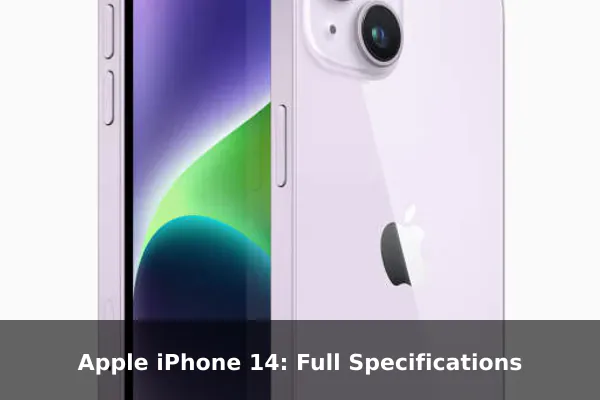
The Apple iPhone 14 sits in a useful middle ground for buyers who want a modern iPhone experience without moving to the newest flagship tier. It keeps the familiar 6.1-inch size, A15 Bionic performance, Ceramic Shield front, dual 12 MP cameras, 5G support, and Apple’s satellite emergency feature set.
This specs-focused overview looks beyond the raw table and frames the iPhone 14 as a value buy: what still feels current, where the hardware is more conservative, and which model variants matter before purchase.
Full Specifications
Network
| Technology: | GSM / CDMA / HSPA / EVDO / LTE / 5G |
| 2G bands: | GSM 850 / 900 / 1800 / 1900 |
| CDMA 800 / 1900 | |
| 3G bands: | HSDPA 850 / 900 / 1700(AWS) / 1900 / 2100 |
| CDMA2000 1xEV-DO | |
| 4G bands: | 1, 2, 3, 4, 5, 7, 8, 12, 13, 17, 18, 19, 20, 25, 26, 28, 30, 32, 34, 38, 39, 40, 41, 42, 46, 48, 66 – A2882, A2884 |
| 1, 2, 3, 4, 5, 7, 8, 11, 12, 13, 14, 17, 18, 19, 20, 21, 25, 26, 28, 29, 30, 32, 34, 38, 39, 40, 41, 42, 46, 48, 53, 66, 71 – A2649, A2881 | |
| 1, 2, 3, 4, 5, 7, 8, 12, 13, 17, 18, 19, 20, 25, 26, 28, 30, 32, 34, 38, 39, 40, 41, 42, 46, 48, 66 – A2883 | |
| 5G bands: | 1, 2, 3, 5, 7, 8, 12, 20, 25, 26, 28, 30, 38, 40, 41, 48, 66, 70, 77, 78, 79 SA/NSA/Sub6 – A2882, A2884 |
| 1, 2, 3, 5, 7, 8, 12, 14, 20, 25, 26, 28, 29, 30, 38, 40, 41, 48, 53, 66, 70, 71, 77, 78, 79, 258, 260, 261 SA/NSA/Sub6/mmWave – A2649 | |
| 1, 2, 3, 5, 7, 8, 12, 14, 20, 25, 26, 28, 29, 30, 38, 40, 41, 48, 53, 66, 70, 71, 77, 78, 79 SA/NSA/Sub6 – A2881 | |
| 1, 2, 3, 5, 7, 8, 12, 20, 25, 26, 28, 30, 38, 40, 41, 48, 66, 70, 77, 78, 79 SA/NSA/Sub6 – A2883 | |
| Speed: | HSPA, LTE, 5G, EV-DO Rev.A 3.1 Mbps |
Launch
| Announced: | 2022, September 07 |
| Status: | Available. Released 2022, September 16 |
Body
| Dimensions: | 146.7 x 71.5 x 7.8 mm (5.78 x 2.81 x 0.31 in) |
| Weight: | 172 g (6.07 oz) |
| Build: | Glass front, glass back, aluminum frame |
| SIM: | Nano-SIM + eSIM + eSIM (max 2 at a time; International)eSIM + eSIM (8 or more, max 2 at a time; USA)Nano-SIM + Nano-SIM (China) |
| IP68 dust tight and water resistant (immersible up to 6m for 30 min) Apple Pay (Visa, MasterCard, AMEX certified) |
Display
| Type: | Super Retina XDR OLED, HDR10, Dolby Vision, 800 nits (HBM), 1200 nits (peak) |
| Size: | 6.1 inches, 90.2 cm2 (~86.0% screen-to-body ratio) |
| Resolution: | 1170 x 2532 pixels, 19.5:9 ratio (~460 ppi density) |
| Protection: | Ceramic Shield glass |
Platform
| OS: | iOS 16, upgradable to iOS 18.6 |
| Chipset: | Apple A15 Bionic (5 nm) |
| CPU: | Hexa-core (2×3.23 GHz Avalanche + 4×1.82 GHz Blizzard) |
| GPU: | Apple GPU (5-core graphics) |
Memory
| Card slot: | No |
| Internal: | 128GB 6GB RAM, 256GB 6GB RAM, 512GB 6GB RAM |
| NVMe |
Main Camera
| Dual: | 12 MP, f/1.5, 26mm (wide), 1/1.7″, 1.9µm, dual pixel PDAF, sensor-shift OIS 12 MP, f/2.4, 13mm, 120˚ (ultrawide) |
| Features: | Dual-LED dual-tone flash, HDR (photo/panorama) |
| Video: | 4K@24/25/30/60fps, 1080p@25/30/60/120/240fps, HDR, Dolby Vision HDR (up to 60fps), stereo sound rec. |
Selfie camera
| Single: | 12 MP, f/1.9, 23mm (wide), 1/3.6″, 1.0µm, PDAF SL 3D, (depth/biometrics sensor) |
| Features: | HDR |
| Video: | 4K@24/25/30/60fps, 1080p@25/30/60/120fps, gyro-EIS |
Sound
| Loudspeaker: | Yes, with stereo speakers |
| 3.5mm jack: | No |
Comms
| WLAN: | Wi-Fi 802.11 a/b/g/n/ac/6, dual-band, hotspot |
| Bluetooth: | 5.3, A2DP, LE |
| Positioning: | GPS, GLONASS, GALILEO, BDS, QZSS |
| NFC: | Yes |
| Radio: | No |
| USB: | Lightning, USB 2.0 |
Features
| Sensors: | Face ID, accelerometer, gyro, proximity, compass, barometer |
| Ultra Wideband (UWB) support Emergency SOS via satellite (SMS sending/receiving) |
Battery
| Type: | Li-Ion 3279 mAh (12.68 Wh) |
| Charging: | Wired, PD2.0, 50% in 30 min 15W wireless (MagSafe) 15W wireless (Qi2) – requires iOS 17.2 update |
Misc
| Colors: | Midnight, Purple, Starlight, Blue, Red, Yellow |
| Models: | A2882, A2649, A2881, A2884, A2883, iphone14,7 |
| SAR: | 1.15 W/kg (head) 1.16 W/kg (body) |
| SAR EU: | 0.98 W/kg (head) 0.98 W/kg (body) |
| Price: | € 395.99 / $ 341.00 / £ 309.95 / ₹ 63,900 |
Our Tests
| Performance: | AnTuTu: 817125 (v9) GeekBench: 4761 (v5.1) GFXBench: 60fps (ES 3.1 onscreen) |
| Display: | 804 nits max brightness (measured) |
| Camera: | Photo / Video |
| Loudspeaker: | -25.2 LUFS (Very good) |
| Battery (old): | Endurance rating 90h |
Price and Availability
The Apple iPhone 14 offers a compelling combination of features and performance. While the base price is around €396, the actual cost may vary depending on your location and retailer. Below, you’ll find the approximate price of the Apple iPhone 14 converted into various currencies. Please note that these are estimates based on recent exchange rates as of May 31, 2026 and may not reflect the exact price you’ll find at a retailer.
- United States: $462
- Japan: ¥73,517
- United Kingdom: £343
- Australia: A$643
- Canada: C$637
- Taiwan: NT$14,477
- Denmark: kr2.955
- Saudi Arabia: ﷼1,731
- South Korea: ₩695,229
- Germany: €396
- Brazil: R$2.328
- Vietnam: ₫12.062.739
- Kenya: KSh 59,680
- India: ₹43,895
- Indonesia: Rp 8.242.457
- Nigeria: ₦624,268
- Pakistan: ₨128,702
- Philippines: ₱28,372
- Bangladesh: ৳৫৬,৬৪৭
Why Should You Buy the Apple iPhone 14?
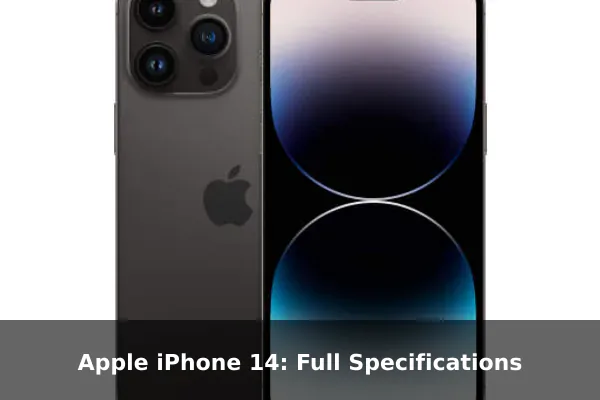
The iPhone 14 is most appealing if you want an iPhone that still feels modern but do not need the newest camera hardware, USB-C, or Pro-series display features. Its core strengths are straightforward: a strong A15 Bionic chip, dependable OLED display quality, polished video recording, compact build, broad 5G support, and long software relevance compared with many phones from the same launch period.
The value angle is important. The supplied price data places the phone well below new flagship territory in several markets, though real retail pricing can vary by storage, region, condition, warranty, and carrier lock status. Buyers comparing it with older iPhones should note that the iPhone 14 brings a newer camera system than the iPhone 13, more RAM in the listed configuration, satellite emergency support, and crash detection, while keeping a very similar physical design.
Design and Durability
Apple kept the iPhone 14 design familiar: a flat aluminum frame, glass back, Ceramic Shield front, and a 172 g body that remains easy to handle one-handed for many users. At 146.7 x 71.5 x 7.8 mm, it is compact by current flagship standards without feeling small for media, messaging, and navigation.
The IP68 rating is a major practical advantage, with dust resistance and water resistance listed up to 6 meters for 30 minutes. That does not make the phone invincible, but it gives the device stronger everyday protection than many mid-range alternatives. The SIM setup is also region-sensitive: international versions can combine Nano-SIM and eSIM, U.S. versions rely on eSIM, and China models support dual Nano-SIM, so buyers should confirm the exact model before importing.
Display Quality
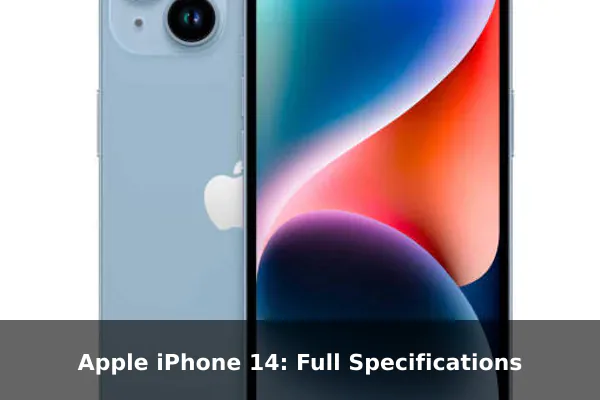
The 6.1-inch Super Retina XDR OLED is one of the iPhone 14’s safest strengths. It has a 1170 x 2532 resolution, around 460 ppi density, HDR10 and Dolby Vision support, 800 nits high brightness mode, and 1200 nits peak brightness for HDR content. The measured 804 nits result in the supplied test data aligns with the expectation that this screen remains comfortable outdoors for typical use.
The main limitation is refresh rate. The iPhone 14 uses a standard 60 Hz panel, so scrolling and animations are not as fluid as on iPhone Pro models or many Android phones with 90 Hz or 120 Hz screens. For users coming from an older iPhone, it will still look crisp and color-rich; for users used to high-refresh displays, it is the most obvious compromise.
Performance and Storage
The Apple A15 Bionic remains a strong chip for daily use, gaming, camera processing, and long-term app support. This version is listed with a 6-core CPU, 5-core GPU, and 6 GB of RAM, which gives the iPhone 14 more breathing room than some older non-Pro iPhones. The supplied benchmark figures, including AnTuTu 817125 and GeekBench 4761, show performance that is still competitive for a value-focused premium phone.
Storage options are 128 GB, 256 GB, and 512 GB, with NVMe storage and no microSD card slot. The 128 GB model is acceptable for lighter users, but anyone who records frequent 4K video, stores large offline media libraries, or keeps phones for several years should consider 256 GB or 512 GB from the start.
Camera Experience
The rear camera system uses two 12 MP sensors: a 26 mm wide camera with f/1.5 aperture, dual pixel PDAF, and sensor-shift optical image stabilization, plus a 13 mm ultrawide camera with a 120-degree field of view. This is not a zoom-focused setup, but it is a strong everyday camera pair for portraits, travel photos, indoor scenes, landscapes, and social media work.
Video remains one of the strongest reasons to choose the iPhone 14. It supports 4K recording up to 60 fps, Dolby Vision HDR up to 60 fps, stereo sound recording, high-frame-rate 1080p slow motion, and stabilized footage. The 12 MP TrueDepth front camera also supports autofocus, 4K video up to 60 fps, HDR, and gyro-EIS, making it a strong option for video calls, short-form content, and selfies.
Battery and Charging
The iPhone 14 uses a 3279 mAh battery rated at 12.68 Wh. The supplied endurance score of 90 hours indicates solid overall stamina for a phone of this size, especially for mixed use rather than continuous heavy gaming or extended 5G hotspot sessions.
Charging is capable but not class-leading. Wired charging supports PD2.0 with a listed 50 percent charge in 30 minutes, while wireless charging includes 15W MagSafe. The source data also lists 15W Qi2 wireless charging with the required iOS 17.2 update. There is no 3.5 mm headphone jack, and the charging/data port is Lightning with USB 2.0 speeds, which matters if you regularly move large video files by cable.
Software and Features
The phone launched with iOS 16, and the supplied data lists upgrade support to iOS 18.6. The larger point is that the iPhone 14 remains part of Apple’s modern software ecosystem, with Face ID, Apple Pay support, UWB, satellite-based Emergency SOS messaging, and deep integration with services such as iMessage, FaceTime, AirDrop, and Find My.
Face ID is handled by the TrueDepth camera system, and the sensor package includes accelerometer, gyro, proximity sensor, compass, and barometer. UWB support is useful for precise location features with compatible Apple accessories, while satellite emergency functionality is a meaningful safety feature in supported regions and conditions.
Connectivity and Model Variants
Connectivity is broad, but model numbers matter. The iPhone 14 supports GSM, CDMA, HSPA, EVDO, LTE, and 5G, with band coverage varying across A2882, A2649, A2881, A2884, and A2883 variants. The A2649 U.S. model is the one listed with mmWave 5G bands n258, n260, and n261, while other versions focus on sub-6 GHz 5G coverage.
Other wireless features include Wi-Fi 6, Bluetooth 5.3, NFC, GPS, GLONASS, GALILEO, BDS, and QZSS. There is no FM radio. Anyone buying internationally should verify carrier band support, eSIM availability, and warranty coverage rather than relying only on the iPhone 14 name.
Who Should Buy This Phone?
The iPhone 14 makes the most sense for buyers upgrading from an iPhone 11, iPhone XR, older Android mid-rangers, or any phone with weak battery life and aging cameras. It is also a practical choice for users who want a compact premium phone, strong video quality, reliable water resistance, and a long-lasting app ecosystem.
It is less ideal for buyers who want a telephoto camera, 120 Hz display, USB-C, very fast charging, or the latest Apple design language. If those features are priorities, newer iPhone models or Pro variants are better targets. If the goal is balanced iPhone performance at a lower price, the iPhone 14 remains easy to justify.
Conclusion
The Apple iPhone 14 is no longer the newest iPhone, but its A15 Bionic chip, polished OLED screen, strong dual-camera video features, IP68 build, 5G connectivity, and satellite emergency support keep it relevant. It is best recommended for buyers who want a dependable modern iPhone at a lower price and can accept the 60 Hz display, Lightning port, and lack of optical zoom.
Official references
- Apple Support – iPhone 14 Tech Specs – Primary Apple technical specification page for iPhone 14 dimensions, display, chip, cameras, battery, connectivity, SIM, sensors, and supported features.
- Apple Newsroom – Apple introduces iPhone 14 and iPhone 14 Plus – Official launch announcement with introduction date, availability, colors, storage options, and feature context for iPhone 14.
- Apple Support – Identify your iPhone model – Official Apple reference for confirming iPhone 14 model numbers and distinguishing device variants.
- Apple – Supported 5G and LTE networks – Official Apple cellular compatibility reference for verifying iPhone network band and carrier support.
- FCC Equipment Authorization System – Official U.S. regulatory database for checking FCC filings and radio authorization details for iPhone 14 model/FCC IDs.
