Homepage/Redmi/Xiaomi Redmi 15C: Full Specifications
Xiaomi Redmi 15C: Full Specifications
Xiaomi Redmi 15C enters the entry-level 5G segment with a clear priorities list: long runtime, a very large screen, and practical everyday features. It is built for users who want reliability first, not flashy benchmark numbers.
The phone combines a 120Hz IPS panel, Dimensity 6300, microSD expansion, and a 6000 mAh battery in a dual-SIM body with IP64 splash resistance. On paper, it aims to be a low-stress daily driver for work, media, and travel.
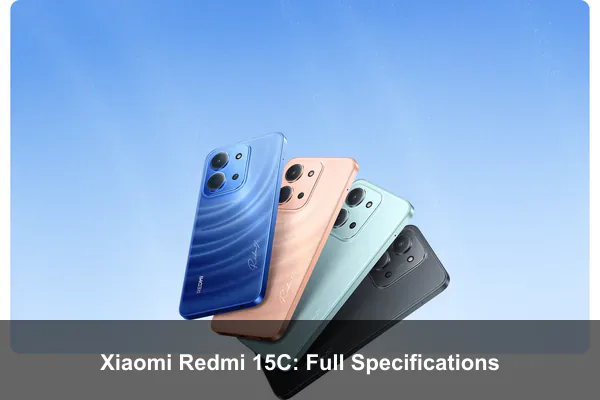
Midnight Black, Mint Green, Dusk Purple, Moonlight Blue
Models
2508CRN2BE, 2508CRN2BC, 2508CRN2BG
SAR EU
0.99 W/kg (head) 0.95 W/kg (body)
Price
£ 139.00 / € 155.49
EU LABEL
Energy
Class A
Battery
69:38h endurance, 1000 cycles
Free fall
Class A (270 falls)
Repairability
Class C
Price and Availability
Price and Availability Xiaomi Redmi 15C: Full Specifications. Image Source: commons.wikimedia.org
The Xiaomi Redmi 15C offers a compelling combination of features and performance. While the base price is around €155, the actual cost may vary depending on your location and retailer. Below, you’ll find the approximate price of the Xiaomi Redmi 15C converted into various currencies. Please note that these are estimates based on recent exchange rates as of March 31, 2026 and may not reflect the exact price you’ll find at a retailer.
United States: $178
Japan: ¥28,477
United Kingdom: £135
Australia: A$260
Canada: C$248
Taiwan: NT$5,714
Denmark: kr1.160
Saudi Arabia: ﷼669
South Korea: ₩270,768
Germany: €155
Brazil: R$935
Vietnam: ₫4.687.323
Kenya: KSh 23,232
India: ₹16,860
Indonesia: Rp 3.031.399
Nigeria: ₦246,578
Pakistan: ₨49,821
Philippines: ₱10,829
Bangladesh: ৳২১,৯৩২
Value Focus: Ownership Cost Over Hype
Redmi 15C is positioned as a budget 5G phone that emphasizes practical long-term value. You get broad 5G support, expandable storage, and UFS 2.2 responsiveness without moving to a higher price tier. Its EU label metrics, including Energy Class A and a 1000-cycle battery rating, strengthen its appeal for buyers who care about longevity and running costs.
Design and Build Practicality
This is a large device, and the 211 g weight reflects that. The upside is a sturdy feel with IP64 dust and splash resistance plus Mohs level 6 screen protection, making it more reassuring for daily commuting and casual outdoor use than many basic entry models.
Display Experience for Daily Media
The 6.9-inch 120Hz IPS panel is tuned for size and smooth scrolling. Brightness up to 810 nits (HBM) helps with outdoor readability, while the HD+ resolution keeps power draw in check. Compared with sharper FHD competitors, this screen is more about comfort and battery efficiency than pixel density.
Performance in Real-World Use
Dimensity 6300 with Cortex-A76 performance cores delivers stable everyday speed for messaging, social apps, streaming, and light gaming. Multiple RAM options up to 8GB and UFS 2.2 storage help reduce basic app load delays, though this is still not a performance-first gaming phone.
Camera Output and Limits
The 50MP main camera is designed for straightforward, good-light photography with HDR support. Video is capped at 1080p at 30fps on both front and rear, which is fine for social content and calls, but users expecting stronger low-light processing or advanced video modes should look higher in the lineup.
Battery Endurance and Charging Flexibility
A 6000 mAh battery is the key strength here, built for very long daily use. Fast charging at 33W and the claimed 50% in 28 minutes make top-ups practical, while 10W reverse wired charging adds utility for accessories and emergency sharing.
Software Lifespan and User Experience
The phone ships with Android 15 and HyperOS 2, with support for up to two major Android upgrades. In the entry segment, that update policy is important for buyers who plan to keep one device for multiple years.
Connectivity and Audio Essentials
Connectivity is one of the strongest parts of this model: wide 4G/5G band coverage by region, dual-band Wi-Fi ac, Bluetooth 5.4, and multi-system positioning. Practical extras like a 3.5mm headphone jack, FM radio, USB-C OTG, and Hi-Res audio support make it friendly for wired-audio and offline-radio users.
Who Should Buy Xiaomi Redmi 15C
This phone makes the most sense for users who want a large display, long battery life, expandable storage, and broad network compatibility at an affordable price. It is ideal for students, delivery workers, commuters, and general users who prioritize endurance and reliability over camera specialization or high-end gaming.
Conclusion
Xiaomi Redmi 15C is a practical budget 5G choice built around battery life, usable performance, and everyday durability. If your priority is dependable daily use with low ownership stress, it is an easy recommendation in its class.