
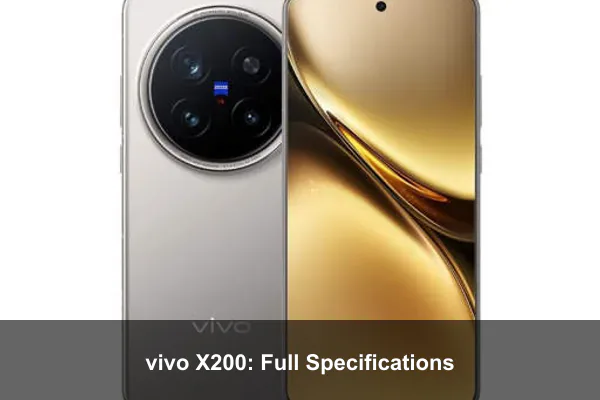
The vivo X200 is a specs-heavy flagship built around MediaTek’s latest 3 nm silicon, a Zeiss-tuned triple 50 MP camera system, and a bright 120Hz AMOLED display.
Rather than repeating the full spec sheet, this guide focuses on real buyer value, regional differences, and how the X200 stacks up on everyday priorities.
Full Specifications
Network
| Technology: | GSM / HSPA / LTE / 5G |
| 2G bands: | GSM 850 / 900 / 1800 / 1900 |
| 3G bands: | HSDPA 850 / 900 / 1700(AWS) / 1900 / 2100 – International |
| HSDPA 800 / 850 / 900 / 1700(AWS) / 1900 / 2100 – China | |
| HSDPA 850 / 900 / 2100 – Malaysia, India | |
| 4G bands: | 1, 2, 3, 4, 5, 7, 8, 12, 17, 18, 19, 20, 26, 28, 32, 38, 39, 40, 41, 42 – International |
| 1, 3, 5, 8, 28, 38, 40, 41 – India | |
| 1, 2, 3, 4, 5, 7, 8, 18, 19, 26, 28, 34, 38, 39, 40, 41, 66 – China | |
| 5G bands: | 1, 3, 5, 7, 8, 20, 26, 28, 38, 40, 41, 75, 77, 78 SA/NSA/Sub6 – International |
| 1, 3, 5, 8, 28, 40, 77, 78 SA/NSA/Sub6 – India | |
| 1, 3, 5, 8, 28, 38, 40, 41, 77, 78 SA/NSA/Sub6 – China | |
| Speed: | HSPA, LTE, 5G |
Launch
| Announced: | 2024, October 14 |
| Status: | Available. Released 2024, October 19 |
Body
| Dimensions: | 160.3 x 74.8 x 8 mm (6.31 x 2.94 x 0.31 in) |
| Weight: | 197 g or 202 g (6.95 oz) |
| Build: | Glass front, aluminum alloy frame, glass back or glass fiber back |
| SIM: | Nano-SIM + Nano-SIM + eSIM (max 2 at a time)Nano-SIM + Nano-SIM |
| IP68/IP69 dust tight and water resistant (high pressure water jets; immersible up to 1.5m for 30 min) IP69 (market/region dependent) |
Display
| Type: | AMOLED, 1B colors, 120Hz, 2160Hz PWM, HDR10+, 4500 nits (peak) |
| Size: | 6.67 inches, 107.4 cm2 (~89.6% screen-to-body ratio) |
| Resolution: | 1260 x 2800 pixels, 20:9 ratio (~460 ppi density) |
| Protection: | Schott Xensation Alpha |
| Ultra HDR image support |
Platform
| OS: | Android 15, up to 4 major Android upgrades, Funtouch 15 (International), OriginOS 5 (China) |
| Chipset: | Mediatek Dimensity 9400 (3 nm) |
| CPU: | Octa-core (1×3.63 GHz Cortex-X925 & 3×3.3 GHz Cortex-X4 & 4×2.4 GHz Cortex-A720) |
| GPU: | Immortalis-G925 |
Memory
| Card slot: | No |
| Internal: | 256GB 12GB RAM, 512GB 12GB RAM, 512GB 16GB RAM, 1TB 16GB RAM |
| UFS 4.0 |
Main Camera
| Triple: | 50 MP, f/1.6, 23mm (wide), 1/1.56″, PDAF, OIS 50 MP, f/2.6, 70mm (periscope telephoto), 1/1.95″, PDAF, OIS, 3x optical zoom 50 MP, f/2.0, 15mm, 119˚ (ultrawide), 1/2.76″, 0.64µm, AF |
| Features: | Laser AF, Zeiss optics, Zeiss T* lens coating, LED flash, panorama, HDR, 3D LUT import |
| Video: | 4K@30/60fps, 1080p@30/60/120/240fps, gyro-EIS |
Selfie camera
| Single: | 32 MP, f/2.0, 20mm (ultrawide) |
| Features: | HDR |
| Video: | 4K@30/60fps, 1080p@30/60fps |
Sound
| Loudspeaker: | Yes, with stereo speakers |
| 3.5mm jack: | No |
Comms
| WLAN: | Wi-Fi 802.11 a/b/g/n/ac/6/7, dual-band |
| Bluetooth: | 5.4, A2DP, LE, aptX HD, LHDC 5 |
| Positioning: | GPS (L1+L5), GLONASS (L1), BDS (B1I+B1c+B2a+B2b), GALILEO (E1+E5a+E5b), QZSS (L1+L5), NavIC (L5) |
| NFC: | Yes |
| Infrared port: | Yes |
| Radio: | No |
| USB: | USB Type-C 2.0, OTG |
Features
| Sensors: | Fingerprint (under display, optical), accelerometer, gyro, proximity, compass |
Battery
| Type: | Si/C Li-Ion 5800 mAh (Global)Li-Ion 5220 mAh (Austria) |
| Charging: | 90W wired Reverse wired |
Misc
| Colors: | Natural Green (Aurora Green), Cosmos Black, Blue, White, Titanium |
| Models: | V2415A, V2405A, V2415 |
| SAR: | 1.00 W/kg (head) 0.78 W/kg (body) |
| Price: | $ 1,032.00 / ₹ 58,990 |
Our Tests
| Performance: | AnTuTu: 2632874 (v10) GeekBench: 8014 (v6) 3DMark: 6334 (Wild Life Extreme) |
| Display: | 1563 nits max brightness (measured) |
| Loudspeaker: | -26.7 LUFS (Good) |
| Battery: | Active use score 14:51h |
Price and Availability
The vivo X200 offers a compelling combination of features and performance. While the base price is around $1,032, the actual cost may vary depending on your location and retailer. Below, you’ll find the approximate price of the vivo X200 converted into various currencies. Please note that these are estimates based on recent exchange rates as of March 27, 2026 and may not reflect the exact price you’ll find at a retailer.
- United States: $1,032
- Japan: ¥164,728
- United Kingdom: £774
- Australia: A$1,495
- Canada: C$1,428
- Taiwan: NT$33,007
- Denmark: kr6.672
- Saudi Arabia: ﷼3,870
- South Korea: ₩1,555,047
- Germany: €894
- Brazil: R$5.401
- Vietnam: ₫27.091.324
- Kenya: KSh 133,879
- India: ₹97,259
- Indonesia: Rp 17.450.783
- Nigeria: ₦1,428,726
- Pakistan: ₨288,625
- Philippines: ₱62,179
- Bangladesh: ৳১,২৬,৭৪০
Value: Flagship Hardware Without Ultra Pricing
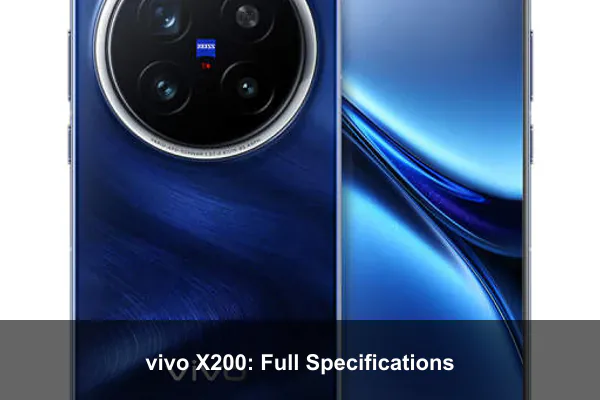
At $1,032 / ₹ 58,990, the X200 sits in premium territory but still looks strong on paper: Dimensity 9400 power, UFS 4.0 storage, and a full triple-50MP camera setup with periscope zoom. Compared with many similarly priced flagships, it prioritizes core hardware quality over flashy extras.
Design and Build Quality
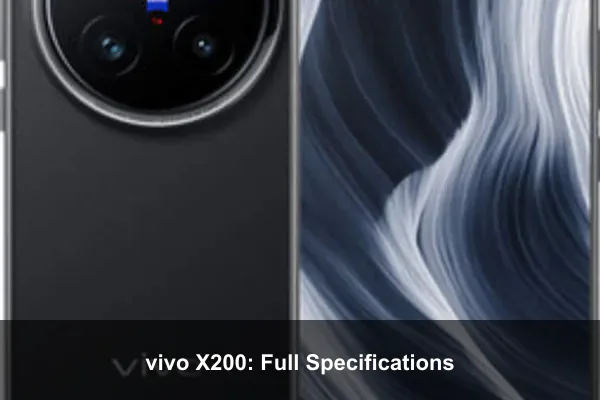
The 160.3 x 74.8 x 8 mm body stays in a mainstream flagship size class, while weight varies between 197 g and 202 g by finish. Materials are premium with an aluminum alloy frame plus glass front and either glass or glass-fiber back. IP68/IP69 protection is a major durability advantage, with exact rating dependent on market version.
Display Quality and Outdoor Use
The 6.67-inch AMOLED panel delivers 1260 x 2800 resolution, 120Hz refresh, HDR10+, and 1B colors. Vivo’s 4500-nit peak claim is paired with measured 1563 nits max brightness, which is still excellent for daylight readability. Schott Xensation Alpha protection, Ultra HDR support, and 2160Hz PWM help make this one of the stronger displays in its class.
Performance and Long-Term Speed
Dimensity 9400 with Immortalis-G925 puts the X200 in true flagship performance range. Test figures (AnTuTu 2,632,874; GeekBench 8,014; 3DMark Wild Life Extreme 6,334) indicate strong headroom for gaming, camera processing, and multitasking. With up to 16GB RAM and 1TB storage, the platform is built for sustained use over multiple years.
Camera System for Practical Versatility
This is a balanced camera package: 50MP main with OIS, 50MP 3x periscope telephoto with OIS, and 50MP ultrawide with autofocus. Zeiss optics, T* coating, laser AF, and 3D LUT import add real creative flexibility beyond basic auto shooting. 4K60 recording on both rear and selfie cameras is a meaningful advantage for hybrid photo-video users.
Battery Life and Charging Strategy
Battery capacity is region-sensitive: 5800 mAh globally, but 5220 mAh for Austria. The posted active use score of 14:51h is competitive for a high-performance 5G flagship. 90W wired charging and reverse wired charging are practical, but buyers expecting wireless charging should note it is not included.
Software and Update Commitment
The phone ships with Android 15 and promises up to four major Android upgrades, which is solid for this tier. International models use Funtouch 15, while Chinese variants run OriginOS 5, so software experience can differ by market. Overall longevity is strong, though a few rivals now offer longer support windows.
Connectivity and Regional Compatibility
Connectivity is comprehensive: broad regional 5G SA/NSA support, Wi-Fi 7, Bluetooth 5.4 with aptX HD and LHDC 5, NFC, and infrared. Multi-band positioning support, including NavIC, is excellent for reliable navigation across countries. The trade-off is USB Type-C 2.0, which is fine for charging but less ideal for fast wired data transfer.
Who Should Buy the vivo X200
The X200 fits users who want top-tier performance, a versatile zoom-capable camera system, and strong battery life in a durable body. It is especially compelling for buyers comparing camera-first flagships below ultra-tier pricing. If you need expandable storage, a 3.5 mm jack, wireless charging, or faster USB transfer speeds, look at alternatives first.
Conclusion
The vivo X200 is a well-rounded flagship with standout display, performance, and camera balance; pick the right regional variant and it is an easy recommendation.
