
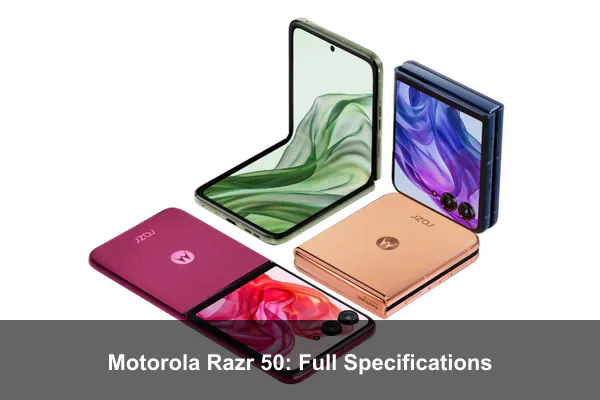
The Motorola Razr 50 targets buyers who want a modern clamshell foldable without jumping to ultra-premium pricing. It combines a large 6.9-inch inner LTPO AMOLED panel with a highly usable 3.6-inch outer display, making it practical both open and closed.
This model focuses on balanced everyday value: solid midrange 5G performance, a stabilized 50MP main camera, stereo speakers, wireless charging, and IPX8 water resistance. On paper, it is positioned as a usability-first foldable rather than a spec-chasing flagship.
Full Specifications
Network
| Technology | GSM / CDMA / HSPA / EVDO / LTE / 5G |
| 2G bands | GSM 900 / 1800 / 1900 |
| CDMA 800 / 1900 | |
| 3G bands | HSDPA 850 / 900 / 1700(AWS) / 1900 / 2100 |
| CDMA2000 1xEV-DO | |
| 4G bands | 1, 2, 3, 4, 5, 7, 8, 12, 13, 17, 18, 19, 20, 25, 26, 28, 32, 38, 39, 40, 41, 42, 43, 66, 71 |
| 5G bands | 1, 2, 3, 5, 7, 8, 20, 26, 28, 38, 40, 41, 66, 71, 77, 78 SA/NSA/Sub6 |
| Speed | HSPA, LTE, 5G |
Launch
| Announced | 2024, June 25 |
| Status | Available. Released 2024, June 25 |
Body
| Dimensions | Unfolded: 171.3 x 74 x 7.3 mm Folded: 88.1 x 74 x 15.9 mm |
| Weight | 188.4 g (6.63 oz) |
| Build | Plastic front (unfolded), glass front (folded, Gorilla Glass Victus), silicone polymer back (eco leather), aluminum frame (6000 series), hinge (stainless steel) |
| SIM | · Nano-SIM + eSIM· Nano-SIM + Nano-SIM |
| IPX8 water resistant (up to 1.5m for 30 min) |
Display
| Type | Foldable LTPO AMOLED, 1B colors, 120Hz, HDR10+, 3000 nits (peak) |
| Size | 6.9 inches, 107.6 cm2 (~84.9% screen-to-body ratio) |
| Resolution | 1080 x 2640 pixels (~413 ppi density) |
| Second external AMOLED, 1B colors, 90Hz, HDR10+, 1700 nits (peak) 3.6 inches, 1056 x 1066 pixels, 413 ppi, Gorilla Glass Victus |
Platform
| OS | Android 14 |
| Chipset | Mediatek Dimensity 7300X (4 nm) |
| CPU | Octa-core (4×2.5 GHz Cortex-A78 & 4×2.0 GHz Cortex-A55) |
| GPU | Mali-G615 MC2 |
Memory
| Card slot | No |
| Internal | 256GB 8GB RAM, 512GB 12GB RAM |
| UFS 2.2 |
Main Camera
| Dual | 50 MP, f/1.7, 25mm (wide), 1/1.95", 0.8µm, dual pixel PDAF, OIS 13 MP, f/2.2, 120˚ (ultrawide), 1/3.0", 1.12µm, AF |
| Features | LED flash, panorama, HDR |
| Video | 4K@30fps, 1080p@30/60fps, gyro-EIS |
Selfie camera
| Single | 32 MP, f/2.4, 25mm (wide), 1/3.14", 0.7µm |
| Features | HDR |
| Video | 4K@30fps, 1080p@30/60fps |
Sound
| Loudspeaker | Yes, with stereo speakers |
| 3.5mm jack | No |
Comms
| WLAN | Wi-Fi 802.11 a/b/g/n/ac/6e, dual-band or tri-band (region dependent) |
| Bluetooth | 5.4, A2DP, LE |
| Positioning | GPS, GLONASS, BDS, GALILEO, QZSS |
| NFC | Yes |
| Radio | No |
| USB | USB Type-C 2.0 |
Features
| Sensors | Fingerprint (side-mounted), gyro, accelerometer, proximity, compass, barometer |
Battery
| Type | 4200 mAh |
| Charging | 30W wired 15W wireless |
Misc
| Colors | Koala Grey (Steel Wool), Beach Sand (Pumice Stone), Spritz Orange (Arabesque) |
| Models | XT2453-1 |
| Price | £ 359.97 / € 493.99 / ₹ 49,999 |
Our Tests
| Performance | AnTuTu: 657381 (v10) GeekBench: 3016 (v5) 3DMark: 856 (Wild Life Extreme) |
| Display | 1289 nits max brightness (measured) |
| Loudspeaker | -23.5 LUFS (Very good) |
| Battery | Active use score 11:46h |
Price and Availability
The Motorola Razr 50 offers a compelling combination of features and performance. While the base price is around €494, the actual cost may vary depending on your location and retailer. Below, you’ll find the approximate price of the Motorola Razr 50 converted into various currencies. Please note that these are estimates based on recent exchange rates as of April 22, 2026 and may not reflect the exact price you’ll find at a retailer.
- United States: $580
- Japan: ¥92,477
- United Kingdom: £430
- Australia: A$811
- Canada: C$792
- Taiwan: NT$18,271
- Denmark: kr3.687
- Saudi Arabia: ﷼2,177
- South Korea: ₩856,150
- Germany: €494
- Brazil: R$2.880
- Vietnam: ₫15.150.839
- Kenya: KSh 75,100
- India: ₹54,291
- Indonesia: Rp 9.931.543
- Nigeria: ₦785,171
- Pakistan: ₨161,913
- Philippines: ₱34,803
- Bangladesh: ৳৭১,২৩৪
Value Positioning
The Razr 50 stands out by bringing key foldable essentials into a more approachable tier: high-refresh displays, OIS on the main camera, eSIM support, and wireless charging. For users comparing clamshell options, its spec mix emphasizes practical features over top-end benchmark numbers.
Design and Build Quality
Motorola uses a premium-feeling material blend for this class, including eco-leather, a 6000-series aluminum frame, Gorilla Glass Victus on the outer panel, and a stainless-steel hinge. At 188.4g with a compact folded form, it is easy to pocket and carry day to day, while IPX8 adds real-world durability confidence.
Display Experience
The 6.9-inch foldable LTPO AMOLED screen delivers 120Hz refresh, HDR10+, and very high peak brightness, while the 3.6-inch external AMOLED runs at 90Hz with strong visibility. This dual-screen setup is one of the phone’s biggest strengths, especially for quick tasks, notifications, and camera preview use without unfolding.
Performance and Hardware
The Dimensity 7300X (4nm) is tuned for efficient daily performance and stable multitasking. Combined with up to 12GB RAM and UFS 2.2 storage, the device is responsive for social, streaming, and productivity workloads, with enough GPU headroom for mainstream gaming at sensible settings.
Camera Practicality
The 50MP main camera with dual-pixel PDAF and OIS is the core shooter here, while the 13MP ultrawide adds flexibility and autofocus support. Video recording up to 4K on both rear and selfie cameras is a strong convenience point for a non-flagship foldable, and the cover display also improves framing for higher-quality self-portraits.
Battery and Charging
A 4200mAh cell is competitive for a slim clamshell form factor, and the tested active-use result supports all-day mixed usage for many users. 30W wired charging plus 15W wireless charging adds flexibility that some foldables in this range still skip.
Software and Longevity
Shipping with Android 14, the Razr 50 offers a current software base and Motorola’s foldable UI conveniences around the cover screen and app continuity. Buyers should still confirm long-term update expectations in their market, but the out-of-box software setup is modern and feature-complete.
Connectivity and Daily Convenience
Connectivity is broad, including extensive 4G/5G band support, Wi-Fi 6e, Bluetooth 5.4, NFC, and dual-SIM options (physical dual-SIM or Nano-SIM plus eSIM). This makes the phone easier to recommend for travelers and users who switch carriers or numbers.
Who Should Buy the Motorola Razr 50
This phone fits buyers who want the foldable experience for communication, content, and lifestyle convenience, but do not need flagship-class chipset power. It is especially appealing to users who prioritize outer-screen usability, compact carry, and balanced everyday specs over maximum raw performance.
Conclusion
The Motorola Razr 50 is a well-rounded clamshell foldable that gets the important things right: usable dual displays, dependable daily performance, solid cameras with OIS, and practical charging options. If you want a foldable that feels modern and functional without stepping into top-tier pricing, this is an easy shortlist recommendation.
