Homepage/Google/HTC Google Nexus One: Full Specifications
HTC Google Nexus One: Full Specifications
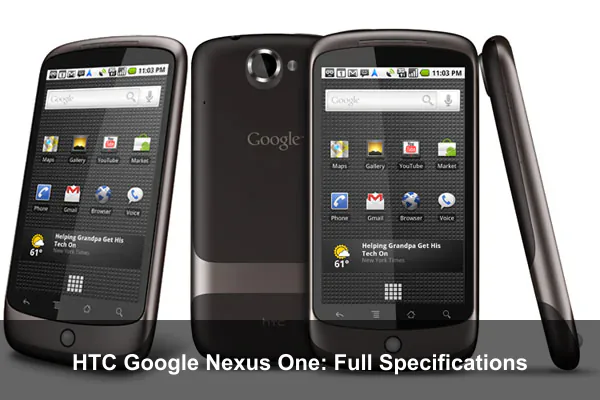
The HTC Google Nexus One launched in January 2010 as one of the earliest Google-led Android flagships, pairing a compact HTC build with a trackball and AMOLED screen.
In 2026, this discontinued model is best viewed as a legacy device for collectors, light backup duty, or classic Android exploration rather than a modern daily driver.
Android 2.1 (Eclair), upgradable to 2.3.6 (Gingerbread)
Chipset
Qualcomm QSD8250 Snapdragon S1
CPU
1.0 GHz Scorpion
GPU
Adreno 200
Memory
Card slot
microSDHC (dedicated slot), 4 GB included
Internal
512MB RAM, 512MB
Main Camera
Single
5 MP, AF
Features
LED flash
Video
480p@24fps
Selfie camera
No
Sound
Loudspeaker
Yes
3.5mm jack
Yes
Comms
WLAN
Wi-Fi 802.11 a/b/g
Bluetooth
2.1, A2DP
Positioning
GPS, A-GPS
Radio
Factory locked by default, can be enabled
USB
microUSB 2.0
Features
Sensors
Accelerometer, proximity, compass
Browser
HTML
Dedicated search key MP3/eAAC+/WAV player MP4/H.264 player Voice memo Predictive text input
Battery
Type
Removable Li-Ion 1400 mAh battery
Stand-by
Up to 290 h (2G) / Up to 250 h (3G)
Talk time
Up to 10 hours (2G) / Up to 7 hours (3G)
Music play
Up to 20 hours
Misc
Colors
Brown (teflon coating)
SAR
0.37 W/kg (head) 0.74 W/kg (body)
Price
About 120 EUR
Our Tests
Camera
Photo
Loudspeaker
Voice 69dB / Noise 66dB / Ring 79dB
Audio quality
Noise -86.1dB / Crosstalk -85.2dB
Price and Availability
Price and Availability HTC Google Nexus One: Full Specifications. Image Source: pexels.com
The HTC Google Nexus One offers a compelling combination of features and performance. While the base price is around €120, the actual cost may vary depending on your location and retailer. Below, you’ll find the approximate price of the HTC Google Nexus One converted into various currencies. Please note that these are estimates based on recent exchange rates as of March 28, 2026 and may not reflect the exact price you’ll find at a retailer.
United States: $138
Japan: ¥22,126
United Kingdom: £104
Australia: A$201
Canada: C$192
Taiwan: NT$4,426
Denmark: kr896
Saudi Arabia: ﷼518
South Korea: ₩208,685
Germany: €120
Brazil: R$724
Vietnam: ₫3.636.151
Kenya: KSh 17,988
India: ₹13,081
Indonesia: Rp 2.342.801
Nigeria: ₦190,876
Pakistan: ₨38,668
Philippines: ₱8,366
Bangladesh: ৳১৬,৯৭০
Value in 2026
The Nexus One sits in a niche value tier: interesting historically, limited practically. With catalog pricing around 120 EUR, the real value comes from collectibility and clean Android heritage, not from current feature competitiveness.
Design and Build
This phone remains notably compact and light by current standards, with a solid HTC chassis, mini-SIM format, and a physical trackball that gives it a distinctive pre-touch-only feel. The brown finish with teflon coating adds to its period-correct identity.
Display Experience
The 3.7-inch AMOLED panel and 480 x 800 resolution still look respectable for basic reading and menus, especially indoors. Against modern devices, brightness, panel size, and screen-to-body efficiency are clearly dated.
Performance for Basic Use
Snapdragon S1, a 1.0 GHz Scorpion CPU, Adreno 200 graphics, and 512MB RAM are enough for core navigation and lightweight legacy apps. Modern multitasking, heavy web pages, and current app demands are beyond this hardware class.
Camera Practicality
The 5 MP autofocus rear camera with LED flash can handle simple daylight shots and documentation. Video capture tops out at 480p at 24fps, and there is no selfie camera, so expectations should stay strictly basic.
Battery and Longevity
The removable 1400 mAh battery is a practical plus for long-term ownership and restoration projects. Official endurance figures were decent for its era, but actual runtime now depends heavily on battery health and network conditions.
Software and App Compatibility
Android 2.1 upgradable to Android 2.3.6 defines the device as a legacy software platform. It is useful for retro Android testing and nostalgia, but current app, security, and service compatibility is very limited.
Connectivity and Network Reality
Connectivity is centered on GSM and HSPA with 7.2/2 Mbps data, plus Wi-Fi a/b/g, Bluetooth 2.1, GPS with A-GPS, and microUSB 2.0. No LTE support means usability depends on remaining 3G availability in your region.
Who Should Buy HTC Google Nexus One
This model fits collectors, Android enthusiasts, and users who want a secondary phone for calls, texts, offline media, or archive purposes. It is not a strong choice for users needing modern apps, camera quality, or long-term network certainty.
Conclusion
The HTC Google Nexus One is best bought as a historic Android collectible with light backup utility; for everyday use, a newer budget Android phone is the better recommendation.