
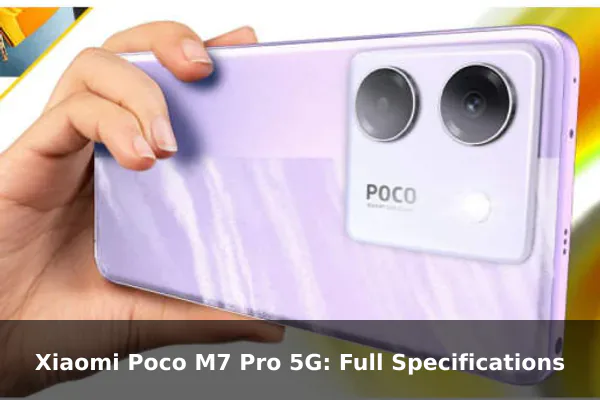
The Xiaomi Poco M7 Pro 5G slots into the mid-range tier with an unusually generous feature set for its asking price, pairing a 120Hz AMOLED panel with a 50 MP OIS-stabilized main camera and a 5,110 mAh battery. Announced on December 17, 2024 and released a few days later on December 20, the handset targets buyers who want flagship-style touches without crossing into upper mid-range territory.
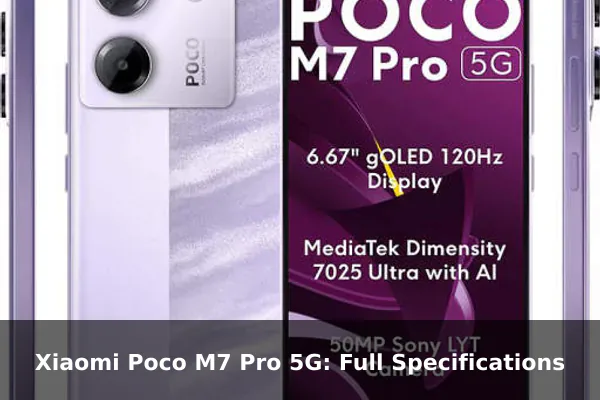
Built around the 6 nm Mediatek Dimensity 7025 Ultra, the M7 Pro 5G arrives with HyperOS on top of Android 14, stereo Dolby Atmos speakers, a 3.5 mm jack, and 45W wired charging. According to the official POCO Global product page, the device is positioned as a balanced everyday performer, and the specs below reflect that intent across display, imaging, and endurance categories.
Full Specifications
Network
| Technology: | GSM / HSPA / LTE / 5G |
| 2G bands: | GSM 850 / 900 / 1800 / 1900 |
| 3G bands: | HSDPA 800 / 850 / 900 / 1700(AWS) / 1900 / 2100 – International |
| HSDPA 850 / 900 / 2100 – India | |
| 4G bands: | 1, 2, 3, 4, 5, 7, 8, 12, 13, 17, 18, 19, 20, 26, 28, 32, 38, 40, 41, 42, 48, 66 – International |
| 1, 3, 5, 8, 28, 40, 41 – India | |
| 5G bands: | 1, 2, 3, 5, 7, 8, 12, 20, 26, 28, 38, 40, 41, 48, 66, 77, 78 SA/NSA – International |
| 1, 3, 5, 8, 28, 40, 78 SA/NSA – India | |
| Speed: | HSPA, LTE, 5G |
Launch
| Announced: | 2024, December 17 |
| Status: | Available. Released 2024, December 20 |
Body
| Dimensions: | 162.4 x 75.7 x 8 mm (6.39 x 2.98 x 0.31 in) |
| Weight: | 190 g (6.70 oz) |
| Build: | Glass front (Gorilla Glass 5), plastic back, plastic frame |
| SIM: | Nano-SIM + Nano-SIM |
| IP64 dust tight and water resistant (water splashes) |
Display
| Type: | AMOLED, 120Hz, 960Hz PWM, HDR10+, 2100 nits (peak), Dolby Vision (India only) |
| Size: | 6.67 inches, 107.4 cm2 (~87.4% screen-to-body ratio) |
| Resolution: | 1080 x 2400 pixels, 20:9 ratio (~395 ppi density) |
| Protection: | Corning Gorilla Glass 5, Mohs level 5 |
Platform
| OS: | Android 14, up to 2 (INT) / 4 (EU) major Android upgrades, HyperOS |
| Chipset: | Mediatek Dimensity 7025 Ultra (6 nm) |
| CPU: | Octa-core (2×2.5 GHz Cortex-A78 & 6×2.0 GHz Cortex-A55) |
| GPU: | IMG BXM-8-256 |
Memory
| Card slot: | microSDXC (uses shared SIM slot) |
| Internal: | 128GB 6GB RAM, 256GB 8GB RAM, 256GB 12GB RAM, 512GB 12GB RAM |
| UFS 2.2 |
Main Camera
| Dual: | 50 MP, f/1.5, 26mm (wide), 1/1.95″, 0.8µm, PDAF, OIS 2 MP, f/2.4, (depth) |
| Features: | LED flash, HDR, panorama |
| Video: | 1080p@30fps |
Selfie camera
| Single: | 20 MP, f/2.2, 21mm (wide), 1/4.0″, 0.7µm |
| Features: | Panorama, HDR |
| Video: | 1080p@30fps |
Sound
| Loudspeaker: | Yes, with stereo speakers (with Dolby Atmos) |
| 3.5mm jack: | Yes |
| 24-bit/192kHz Hi-Res audio |
Comms
| WLAN: | Wi-Fi 802.11 a/b/g/n/ac, dual-band |
| Bluetooth: | 5.0, A2DP, LE |
| Positioning: | GPS, GLONASS, GALILEO, BDS |
| NFC: | Yes (market/region dependent) |
| Infrared port: | Yes |
| Radio: | FM radio (market/region dependent) |
| USB: | USB Type-C |
Features
| Sensors: | Fingerprint (under display, optical), accelerometer, gyro, compass |
| Virtual proximity sensing |
Battery
| Type: | Li-Po 5110 mAh |
| Charging: | 45W wired |
Misc
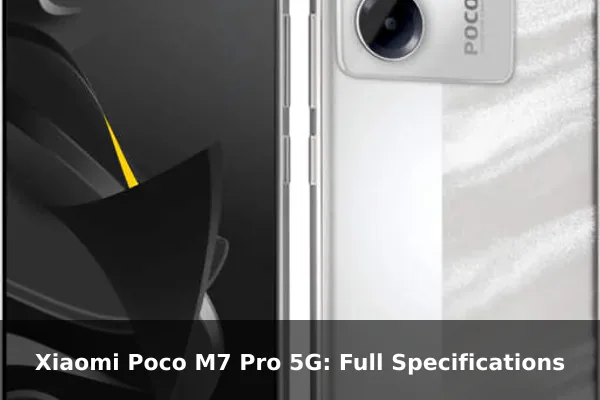
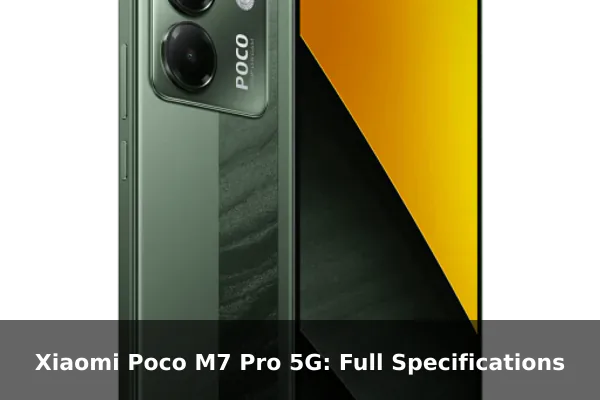
| Colors: | Lavender Frost, Lunar Dust, Olive Twilight, Classic Black |
| Models: | 2409FPCC4G, 2409FPCC4I |
| SAR: | 0.86 W/kg (head) 0.79 W/kg (body) |
| Price: | € 165.00 / $ 240.03 / £ 148.00 / ₹ 12,888 |
Our Tests
| Loudspeaker: | -23.3 LUFS (Very good) |
| Battery: | Active use score 11:21h |
EU LABEL
| Energy: | Class D |
| Battery: | 37:46h endurance, 1000 cycles |
| Free fall: | Class D (45 falls) |
| Repairability: | Class C |
Price and Availability
The Xiaomi Poco M7 Pro 5G offers a compelling combination of features and performance. While the base price is around €165, the actual cost may vary depending on your location and retailer. Below, you’ll find the approximate price of the Xiaomi Poco M7 Pro 5G converted into various currencies. Please note that these are estimates based on recent exchange rates as of June 4, 2026 and may not reflect the exact price you’ll find at a retailer.
- United States: $192
- Japan: ¥30,635
- United Kingdom: £143
- Australia: A$268
- Canada: C$266
- Taiwan: NT$6,026
- Denmark: kr1.231
- Saudi Arabia: ﷼718
- South Korea: ₩292,941
- Germany: €165
- Brazil: R$963
- Vietnam: ₫5.009.135
- Kenya: KSh 24,803
- India: ₹18,328
- Indonesia: Rp 3.442.532
- Nigeria: ₦260,441
- Pakistan: ₨53,397
- Philippines: ₱11,831
- Bangladesh: ৳২৩,৫১০
Value Positioning in the Mid-Range Tier
At an indicative launch price of around €165 / $240 / £148 / ₹12,888, the Poco M7 Pro 5G undercuts many similarly equipped rivals while still offering an OIS-stabilized main camera, an AMOLED panel with HDR10+, and stereo speakers. Buyers shopping in this bracket typically have to choose between display quality, camera stabilization, or charging speed, and Poco has bundled all three into a single device. As with any pricing detail, regional variants and promotional discounts may shift the figure, so checking the official Xiaomi or POCO storefront for your market is advised before purchase.
Design, Build, and Durability
The handset measures 162.4 x 75.7 x 8 mm and tips the scales at 190 g, which is well within mainstream expectations for a 6.67-inch device. The front uses Corning Gorilla Glass 5 with a Mohs level 5 hardness rating, while the back and frame are plastic to keep weight and cost in check. IP64 certification covers dust ingress and water splashes, though it is not rated for submersion. According to the European Commission’s EPREL listing for model 2409FPCC4G, the device falls into Class D for free-fall durability after 45 drops, which is a realistic benchmark for everyday accidents rather than extreme abuse.
Display: 120Hz AMOLED With HDR10+
The 6.67-inch AMOLED panel pushes a 1080 x 2400 resolution at a 20:9 aspect ratio, yielding roughly 395 ppi. Refresh rate tops out at 120Hz, and Poco lists 960Hz PWM dimming, which can help reduce eye strain at low brightness for sensitive users. Peak brightness is rated at 2,100 nits, with HDR10+ support across the board and Dolby Vision reserved for the India variant. Screen-to-body ratio sits at approximately 87.4%, giving the front a modern, edge-leaning look.
Performance and Memory Options
Power comes from the Mediatek Dimensity 7025 Ultra, a 6 nm chip built on an octa-core layout with two Cortex-A78 cores at 2.5 GHz and six Cortex-A55 cores at 2.0 GHz, paired with an IMG BXM-8-256 GPU. Memory configurations span 6/128 GB, 8/256 GB, 12/256 GB, and 12/512 GB, all using UFS 2.2 storage, while a hybrid microSDXC slot allows further expansion at the cost of a second SIM. The chipset is engineered for sustained mid-range workloads, social apps, and casual gaming rather than top-tier titles at maximum settings.
Camera System and Imaging
The dual main array centers on a 50 MP, f/1.5 wide sensor with a 1/1.95-inch optical format, 0.8 µm pixels, PDAF, and optical image stabilization, paired with a 2 MP depth assistant. A 20 MP, f/2.2 selfie camera handles the front. Video tops out at 1080p at 30 fps from both cameras, which is modest by 2024 standards but consistent with the chipset’s media pipeline. OIS on the main camera is the headline feature, and it should help low-light handheld stills more than a higher resolution count would.
Battery Life and Charging
A 5,110 mAh Li-Po battery supports 45W wired charging. In manufacturer-cited internal testing, the active-use score lands around 11 hours and 21 minutes, while the EPREL EU label records a 37 hour 46 minute endurance rating and a 1,000-cycle battery life classification. Energy efficiency lands at Class D on the EU label, so the panel and chipset are tuned for usability and brightness rather than maximum frugality. Wireless and reverse charging are not supported.
Software, Updates, and HyperOS
The Poco M7 Pro 5G ships with Android 14 under HyperOS. Update commitments differ by region, with up to 2 major Android upgrades for International units and up to 4 for EU units, alongside the corresponding security patch cycles. Buyers in markets with shorter update windows may want to factor that into the value calculation, particularly if they plan to keep the phone for three or more years.
Connectivity and Audio
5G coverage is broad on International units, spanning bands 1, 2, 3, 5, 7, 8, 12, 20, 26, 28, 38, 40, 41, 48, 66, 77, and 78 in SA/NSA modes, while Indian units cover a tighter 1, 3, 5, 8, 28, 40, and 78 selection. Wi-Fi tops out at Wi-Fi 5 (802.11 a/b/g/n/ac, dual-band) and Bluetooth at 5.0, which is below some competitors that have moved to Wi-Fi 6 and Bluetooth 5.3. The phone retains a 3.5 mm headphone jack and adds 24-bit/192 kHz Hi-Res audio, dual stereo speakers with Dolby Atmos, an infrared blaster, NFC and FM radio where supported by region, and USB Type-C.
Who Should Buy the Poco M7 Pro 5G
This phone makes the most sense for buyers who prize a bright AMOLED display, an OIS-equipped main camera, and long battery life over headline gaming performance or 4K video capture. Students, secondary-device buyers, and anyone upgrading from an older budget LCD phone will see a notable jump. Power users chasing high-refresh competitive gaming, frequent 4K recording, or the latest Wi-Fi 6E and Bluetooth 5.3 connectivity should instead look at the slightly pricier Poco X-series or comparable competitors.
Conclusion
The Xiaomi Poco M7 Pro 5G delivers a remarkably well-rounded package at its price point, anchored by a bright 120Hz AMOLED, an OIS-stabilized 50 MP main camera, fast 45W charging on a 5,110 mAh cell, and durable Gorilla Glass 5. Compromises exist in the form of Wi-Fi 5, Bluetooth 5.0, plastic build elements, and capped 1080p video, but none feel out of place for the segment. For shoppers seeking mid-range value with a few flagship-flavored touches, this is a confident recommendation, provided the regional update policy and pricing align with your needs at the time of purchase.
Official references
- Xiaomi Global POCO M7 Pro 5G specifications – Primary official specifications page for processor, RAM/storage variants, dimensions, display, cameras, battery, charging, network bands, sensors, OS, and package contents.
- POCO Global POCO M7 Pro 5G product page – Official POCO product overview for headline features, design/color information, marketing claims, and manufacturer footnotes.
- Xiaomi Global Certification – Official Xiaomi certification hub for user manuals, declarations of conformity, and RF exposure information relevant to device compliance facts.
- European Commission EPREL entry for POCO 2409FPCC4G – Official EU product registration for the POCO model identifier 2409FPCC4G, useful for battery endurance, energy label, repairability, ingress protection, and durability data.
- FCC Equipment Authorization System – Official FCC database to verify filings for FCC ID 2AFZZPCC4G, including radio authorization, SAR/RF exposure, and wireless compliance documents.
